
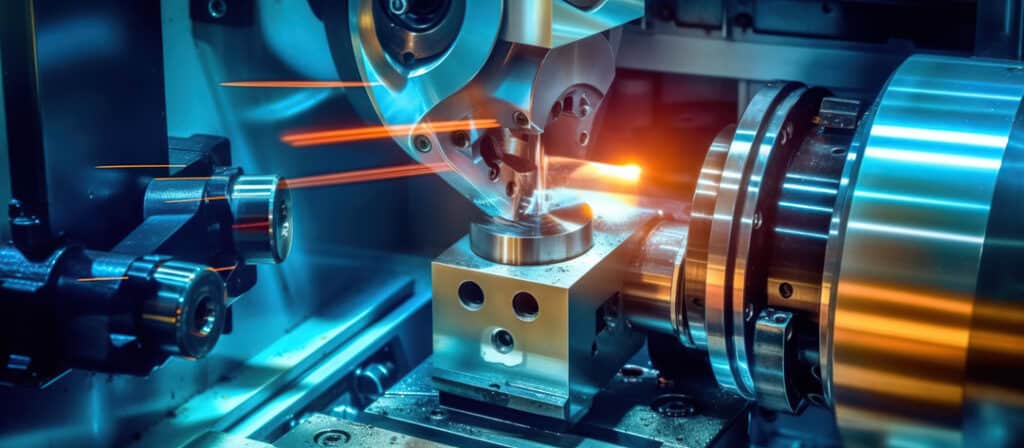
If you've ever held a component that fits perfectly, the kind where tolerances are measured in ten-thousandths of an inch, you already understand the result of precision machining equipment done right. What you may not know is which specific types of machinery and tools make that level of accuracy possible, consistently, across thousands of production runs.
At Shamrock Precision, our Dallas, TX, facility has operated precision CNC machining equipment since 1981. In that time, we've seen the machinery evolve dramatically, from manual lathes to full 5-axis CNC Swiss turning centers. Still, the core principle hasn't changed: the right machine, running the right tooling, in the hands of a skilled machinist, is what separates a production-grade part from a prototype guess.
This guide covers every major category of machinery and tooling used in modern precision machining operations, from the workhorses you'll find in virtually every serious machine shop to the specialized equipment reserved for the most demanding aerospace and oil and gas components. If you're sourcing machined parts, evaluating a shop's capabilities, or just trying to understand what your manufacturer actually does, this is the complete breakdown.
What Is Precision Machining Equipment?
Before we get into the specific machine types, it helps to understand what separates precision machining equipment from general manufacturing machinery.
Precision machining equipment is defined by its ability to hold extremely tight dimensional tolerances, typically ±0.001″ or tighter, with high-end applications reaching ±0.0001″, while maintaining repeatability across high production volumes. These aren't machines you operate by feel. Every axis of movement is computer-controlled, every cut depth programmed to the micron, and every finished part measured against an engineering drawing before it leaves the floor.
What separates a capable precision shop from a general job shop is the combination of machine platform, tooling, and quality systems working together. The sections below cover each major equipment category and what it actually does on the shop floor.
Which Tool Is Used to Shape Metal with Precision? The Core Machine Categories
This is one of the most searched questions in precision manufacturing, and the honest answer is: there's no single tool. High-precision metal components are shaped through a combination of machine types, each suited to specific geometries, materials, and tolerance requirements. Here's how each category works in a real production environment.
CNC Turning Machines — Precision in Rotation
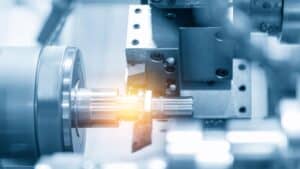
CNC turning is the process of rotating a workpiece against a stationary cutting tool to create cylindrical shapes, shafts, pins, bushings, threaded components, and any part with rotational symmetry. The workpiece spins at controlled speeds while the tool removes material in programmed passes.
What CNC turning machines are used for:
- Cylindrical components: shafts, spindles, pins, axles
- Threaded fasteners and fittings
- Hydraulic cylinder components
- Oil and gas downhole parts including API-spec components
- Small-diameter parts requiring tight roundness tolerances
Modern CNC turning centers go far beyond simple rotation. Live tooling capability allows milling, drilling, and tapping operations to be performed in the same setup, without moving the part to a second machine. This dramatically reduces setup variation, which is one of the biggest sources of tolerance drift in multi-operation machining.
At Shamrock Precision, our CNC turning services handle everything from high-volume production runs of oil and gas components to precision aerospace parts in stainless steel, titanium, and Inconel. Our turning centers operate with tolerances as tight as ±0.0002″ on diameter.
Turning machine specifications that matter when evaluating a shop:
- Bar stock capacity (diameter of material the machine can feed)
- Max turning diameter and length
- Live tooling positions
- Sub-spindle capability for complete part machining in one cycle
- Spindle speed range
CNC Milling Machines — Versatility Across Complex Geometries
Where turning handles rotational parts, CNC milling handles everything else. In milling, the cutting tool rotates while the workpiece remains stationary (or moves linearly). This allows the creation of flat surfaces, pockets, slots, contours, holes, and complex 3D profiles that a lathe could never produce.
What CNC milling machines are used for:
- Structural and housing components with complex geometry
- Aerospace brackets, frames, and structural plates
- Mold cavities and tooling
- Flat surfaces requiring tight parallelism and squareness
- Parts with multiple features across several faces
The evolution from 3-axis to 4-axis and 5-axis milling is one of the most significant developments in modern precision machining. Standard 3-axis machines move along X, Y, and Z linear axes. 4-axis machines add a rotary axis (A), and 5-axis machines add a second rotary axis (B or C), allowing the cutting tool to approach the workpiece from virtually any angle.
Why 5-axis milling matters for precision machining:
A part that requires machining on four sides would traditionally need four separate setups on a 3-axis machine. Each time you reposition a part, you introduce setup error. With 5-axis simultaneous machining, you can machine complex geometry in a single setup, which means tighter feature-to-feature relationships and faster cycle times.
Our CNC milling services include both 3-axis and multi-axis milling, with capabilities across aluminum, stainless steel, titanium, Inconel, and engineering plastics. For a detailed comparison of when to use turning vs. milling for your specific components, see our guide: CNC turning vs. CNC milling — which process is right for your part?
Milling equipment specifications to evaluate:
- Number of axes (3-axis, 4-axis, 5-axis, simultaneous 5-axis)
- Spindle speed and power
- Table size and work envelope
- Tool changer capacity (number of tools in carousel)
- Accuracy and repeatability ratings (check the machine builder's specs, not just marketing claims)
Swiss-Type CNC Automatic Lathes — The Precision Standard for Small, Complex Parts
Swiss machining, formally called Swiss-type CNC turning or Swiss-type automatic lathe machining, is a specialized variant of CNC turning designed specifically for small-diameter, high-precision, high-volume components. The name comes from the Swiss watchmaking industry, where the technology originated to produce tiny gear shafts and pinions to exact tolerances.
Swiss machines are uniquely suited to small-diameter, high-volume, high-complexity parts — the kind where running multiple tools simultaneously in a single automatic cycle is the only economical path to ±0.0001″ tolerances. Common applications include aerospace fasteners, hydraulic fittings, oilfield instrumentation components, and precision-engineered shear screws used in well control equipment.
To understand how Swiss machining works at a deeper level, read: Swiss machining: how it works and when to use it
Our Swiss machining services serve aerospace, defense, oil and gas, and industrial customers who need high-volume precision small parts with documented quality records. Every lot ships with full traceability under our AS9100 Rev D and ISO 9001 certified quality system.
5-Axis CNC Machining Centers — Handling the Most Complex Components
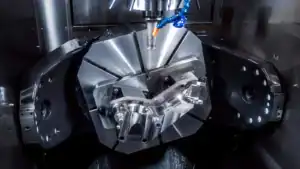
Five-axis machining represents the upper tier of CNC milling capability. When a component has features on multiple faces, undercuts, compound angles, or organic curved surfaces, 5-axis is typically the only practical solution, or at least the most economical one compared to multiple setups on simpler equipment.
In true simultaneous 5-axis machining, all five axes move at the same time. The cutting tool can maintain a constant optimal angle to the workpiece surface regardless of where it is in the cut, which improves surface finish, extends tool life, and allows access to features that are geometrically impossible for 3-axis machines to reach.
The industries that depend most heavily on 5-axis capability — aerospace, defense, oil and gas, and medical — are precisely the sectors where Shamrock Precision operates. For a complete technical breakdown of 5-axis machining including machine types, axis configurations, and cost considerations, see our dedicated guide: 5-Axis Machining in Precision Manufacturing.
Grinding Machines — Fine-Tuning Dimensional Accuracy and Surface Finish
Grinding is a precision machining process that uses abrasive wheels to remove very small amounts of material from a workpiece. It's typically the final machining operation on hardened steel components, used when the required surface finish or dimensional tolerance is tighter than cutting tools can reliably achieve.
Types of grinding machines used in precision machining:
Surface grinders move a workpiece under a rotating grinding wheel to produce flat, highly parallel surfaces. Tolerances of ±0.0001″ on flatness are achievable. Surface grinding is common in toolmaking, mold work, and any application requiring extremely precise mating surfaces.
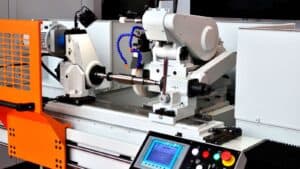
Cylindrical grinders (OD grinders) work on the outside diameter of round parts after turning, bringing the final diameter and surface finish to spec on hardened shafts, bearing journals, and similar components.
Centerless grinders support the workpiece on a work rest blade between two wheels rather than between centers, allowing continuous through-feed grinding of round bars. This is the standard process for producing precision ground bar stock and high-volume small parts like pins and rollers.
ID grinders (internal diameter grinders) finish the bores of housings, bushings, and rings to precise internal diameters and surface finishes.
Grinding is essential when components must survive harsh operating environments; hardened steel parts in oil and gas equipment, for example, often require ground bearing surfaces to ensure long service life under load.
Electrical Discharge Machining (EDM) — Precision Without Cutting Forces
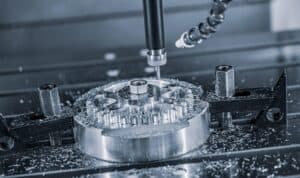
Electrical Discharge Machining is a non-contact, non-cutting machining process that removes material through controlled electrical discharges (sparks) between an electrode and the workpiece. Because there's no physical cutting force, EDM can machine hardened materials that would destroy conventional cutting tools, and it can produce features, sharp internal corners, extremely deep narrow slots, and intricate cavities that no rotating cutter can reach.
Wire EDM uses a continuously fed thin wire (typically brass, 0.004″–0.012″ diameter) as the electrode. The wire follows a CNC-programmed path and erodes the workpiece material by spark erosion, producing precise 2D profile cuts through any thickness of material. Wire EDM is the standard process for cutting punch and die sets, intricate contoured profiles in hardened steel, and extrusion dies.
Sinker EDM (also called ram EDM or die-sinking EDM) uses a shaped electrode, typically machined from graphite or copper, to erode a mirror-image cavity into the workpiece. This is how injection mold cavities, turbine blade root forms, and other complex 3D cavities are produced in hardened tool steel.
What EDM can and can't do:
- ✅ Machine any electrically conductive material regardless of hardness
- ✅ Produce sharp internal corners (impossible with round milling cutters)
- ✅ Machine extremely thin walls without deflection
- ❌ Cannot machine non-conductive materials (ceramics, plastics)
- ❌ Slower material removal rate than conventional cutting, not suited for roughing large volumes of material
What Equipment Is Needed for Specialty Machining Services?
This is a question we hear often from engineers and procurement managers evaluating machine shops. The answer depends heavily on what you're making, but a full-service precision shop capable of handling aerospace, defense, and oil and gas work needs this core equipment stack:
Core production equipment a capable precision machine shop should have:
| Equipment Type | What It Handles |
|---|---|
| CNC turning centers with live tooling | Cylindrical parts, fittings, threaded components |
| CNC vertical machining centers (VMC) | Prismatic parts, pockets, complex surfaces |
| CNC horizontal machining centers (HMC) | High-production prismatic parts, pallet systems |
| Swiss-type CNC automatic lathes | Small-diameter high-precision parts, high volume |
| 5-axis CNC machining centers | Complex geometry, multi-face parts |
| CNC grinding (surface, cylindrical, centerless) | Hardened parts, final-dimension finishing |
| Wire EDM | Contour cutting in hardened materials, tooling |
| Sinker EDM | Mold cavities, complex 3D erosion |
Quality and inspection equipment (equally critical):
| Equipment Type | What It Verifies |
|---|---|
| Coordinate Measuring Machine (CMM) | 3D dimensional verification of complex geometry |
| Optical comparators | 2D profile verification against overlays |
| Surface roughness testers | Surface finish (Ra) measurement |
| Bore gauges, micrometers, calipers | In-process measurement by machinists |
| Vision measurement systems | Small feature measurement, thread verification |
| Hardness testers | Material hardness verification post-heat treat |
A shop that can only inspect what it makes isn't really doing precision work — it's making parts and hoping. At Shamrock Precision, every component goes through documented precision inspection and precision testing before release. Our CMM inspection capability covers parts from the smallest Swiss-machined components to larger structural aerospace parts.
For a full account of why inspection is inseparable from precision machining, read: The importance of testing and inspection in precision manufacturing
What Are the Different Types of CNC Machines Used in Precision Manufacturing?
CNC machines in a full-service precision machining operation fall into four practical categories:
- Turning machines rotate the workpiece against a cutting tool: CNC turning centers, multi-axis turning centers with live tooling, and Swiss-type automatic lathes for small-diameter work.
- Milling machines rotate the cutting tool against a stationary workpiece: vertical machining centers (VMC), horizontal machining centers (HMC), and 5-axis machining centers for complex geometry.
- Grinding machines use abrasive wheels for final-dimension finishing on hardened parts, surface grinders, cylindrical grinders, and centerless grinders.
- Non-conventional machines remove material without a cutting tool; wire EDM and sinker EDM use controlled spark erosion to produce features that no rotating cutter can achieve.
Most serious precision shops run a mix of all four categories. The right machine for a given part depends on its geometry, material, required tolerance, and production volume, not on any one machine type being universally superior.
Precision Measurement and Inspection Equipment — The Last Line of Accuracy
No discussion of precision machining machinery is complete without covering inspection equipment. A machine that cuts to ±0.0002″ is only useful if you can verify it actually hit that tolerance, and do so consistently, with documentation.
The standard inspection equipment in a precision machining operation includes:
Coordinate Measuring Machines (CMM): 3D dimensional verification of complex geometry, used for first article inspection and production lot approval
Optical comparators: 2D profile verification against nominal overlays
Surface profilometers: Measure surface roughness (Ra) to confirm finish requirements are met
Calibrated hand gauging: In-process checks by machinists throughout the production run
A shop without documented inspection capability, regardless of how advanced its CNC equipment is, cannot reliably produce precision parts. Shamrock Precision's full inspection process is documented on our precision inspection services and precision testing pages. For a deeper look at why inspection is inseparable from the machining process, read: The Importance of Testing and Inspection in Precision Manufacturing.
Precision Machining Equipment for Aerospace and Defense Applications
Aerospace and defense machining places demands on equipment that go well beyond general industrial manufacturing. When a component goes into an aircraft structural assembly or a defense system, the tolerance isn't a suggestion; it's a flight safety requirement.
What makes aerospace machining equipment requirements different:
- Material capability: Aerospace alloys, titanium (Ti-6Al-4V), Inconel 718, 17-4 PH stainless, 7075-T651 aluminum, are harder, tougher, and more heat-sensitive than standard steels. This demands rigid machines with high-torque spindles, through-spindle coolant delivery, and advanced tool management.
- Multi-axis capability: Aerospace structural parts often have complex angled features, compound curves, and tight positional tolerances across multiple datum references. 5-axis machining is frequently required.
- Documentation: AS9100 and ITAR-compliant shops must maintain full material traceability from raw stock certifications through every machining operation to final inspection records.
- First Article Inspection (FAI): Per AS9100 requirements, every new part number requires a formal FAI before production release.
Shamrock Precision's aerospace machining capabilities are built around our AS9100 Rev D and ITAR certifications. We machine complex aerospace components in titanium, Inconel, stainless, and aluminum alloys, with full CMM inspection and documented FAI packages. Our capabilities page provides a complete list of equipment, materials, and certifications.
For further reading on aerospace machining standards and compliance requirements, see: Why AS9100 and ITAR compliance define access to the defense aerospace supply chain
Precision Machining Equipment for Oil and Gas Applications
The oil and gas industry, particularly downhole drilling and completion equipment, operates in some of the most hostile environments that machined components will ever face. High pressure, elevated temperature, corrosive fluids, and cyclic mechanical loading are the norm, not the exception.
For operators in the Permian Basin, Eagle Ford, and across the Texas oilfields, the cost of a component failure downhole is enormous: the well is shut in, the drillstring has to be pulled, and the failure mechanism has to be identified before operations can resume. That's why precision matters not just at the time of manufacture; it matters for the service life of the component.
Equipment and capabilities that matter for oil and gas precision machining:
- CNC turning with API thread-cutting capability: Oil country tubular goods (OCTG) and downhole tools use API-specified thread forms that must be cut and gauged to exact standards.
- Materials expertise: 4130, 4140, 4340 alloy steels; 17-4 PH stainless; Inconel 625 and 718 for high-temperature applications; and H2S-service-rated materials for sour well environments.
- Surface finish capability: Sealing surfaces on downhole components often require specific Ra values to ensure metal-to-metal or elastomer seal engagement.
- Traceability: Material certs, heat and lot number traceability, and dimensional records must follow every component.
Shamrock Precision manufactures a range of oil and gas components, including precision-engineered shear screws and safety-critical components used in blowout preventers and other well control equipment. Our oil and gas machining work is done under API Q1 certification, and we maintain ITAR registration for defense-related downhole programs.
We serve Texas operators across all major producing basins, with location and contact information available on our Google Business Profile.
Which Machining Tools Provide the Best Combination of Speed and Precision in Heavy Industry?
For engineers evaluating machining processes for high-production industrial components, this tradeoff between speed and precision is central to process selection. The answer isn't a single tool; it's a combination of machine platform and cutting tool technology.
For high-volume production of round parts: Swiss-type CNC automatic lathes offer the best combination of speed (multiple tools cutting simultaneously in one cycle) and precision (near-zero deflection on small-diameter stock). For parts that are simple enough, multi-spindle CNC screw machines are even faster, though with less flexibility.
For complex prismatic parts in medium volumes: Horizontal machining centers with pallet changers allow lights-out production (the machine runs unattended through shift changes and overnight) with the precision of full CNC control.
For high-mix, low-volume specialty parts: 5-axis machining centers reduce setups and maintain tight feature-to-feature relationships that would degrade through multiple repositioning operations.
For the hardest materials (tool steel, Inconel, ceramics): EDM — either wire or sinker — provides precision without the cutting forces that would deflect or damage fragile features in hard materials.
The key insight is that "fastest" and "most precise" aren't always in conflict — the right machine platform minimizes the tradeoff. Matching the process to the part geometry, material, and volume is the most important decision a manufacturing engineer makes before a single chip is cut.
See how machining decisions affect industrial applications in our article: CNC milling across industries
Ready to Source Precision Machined Parts in Dallas, TX?
Shamrock Precision has operated from Dallas, Texas since 1981. We hold AS9100 Rev D, ISO 9001, API Q1, and ITAR certifications and serve aerospace, defense, oil and gas, and industrial customers across North America. Our full capabilities include CNC turning, CNC milling, Swiss machining, and precision inspection, all under one roof with documented quality systems.
Contact our team for a quote → or find us on Google Maps.
Frequently Asked Questions — Precision Machining Equipment and Tools
Q: What types of machinery are typically used in precision machining?
The core machines are CNC turning centers, CNC milling machines (vertical and horizontal), Swiss-type automatic lathes, 5-axis machining centers, CNC grinding machines, and EDM equipment. Every serious shop also runs inspection machinery, CMMs, optical comparators, and surface profilometers. The right mix depends on part size, geometry, material, and tolerance requirements.
Q: Which tool is used to shape metal with precision?
There's no single answer; it depends on the part. CNC turning centers handle round components. CNC milling machines handle complex geometry. Grinding machines finish hardened parts to final tolerance. EDM reaches features no rotating cutter can — sharp internal corners, deep slots, hard-material cavities. The right process is matched to geometry, material, and required tolerance.
Q: What is precision machining equipment?
Precision machining equipment refers to CNC-controlled machine tools that hold tolerances of ±0.001″ or tighter, with critical applications reaching ±0.0001″. Accuracy comes from servo-driven axes, rigid machine construction, precision spindles, and closed-loop control systems. It includes CNC lathes, machining centers, Swiss-type lathes, grinding machines, and EDM, any machine where dimensional accuracy is the primary requirement.
Q: What equipment is needed for specialty machining services?
A capable specialty shop, one handling aerospace, defense, or oil and gas work, needs CNC turning centers with live tooling, vertical and horizontal machining centers, Swiss-type lathes, 5-axis capability, CNC grinding, wire and sinker EDM, and a full CMM inspection lab. Certifications like AS9100 and API Q1 are equally important as the equipment itself.
Q: What are the different types of CNC machines used in precision manufacturing?
Four categories cover most precision work. Turning machines — lathes and Swiss-type lathes — produce round components. Milling machines — VMCs, HMCs, and 5-axis centers — produce complex geometry. Grinding machines finish hardened parts to final dimension. Non-conventional machines — wire EDM and sinker EDM — remove material by spark erosion where cutting tools physically cannot reach.
Q: What is the difference between conventional machining and precision machining?
Conventional machining works to tolerances of ±0.010″ or looser, acceptable for structural and general fabrication work. Precision machining targets ±0.001″ or tighter, with aerospace and medical applications reaching ±0.0001″. The difference isn't just tighter numbers — it's CNC-controlled equipment, calibrated inspection on every part, documented traceability, and quality systems like AS9100 or API Q1 backing every production run.
Published by the Shamrock Precision Engineering Team | Dallas, TX | Serving aerospace, defense, energy, and industrial customers since 1981 | AS9100 Rev D | ISO 9001 | API Q1 | ITAR Registered