
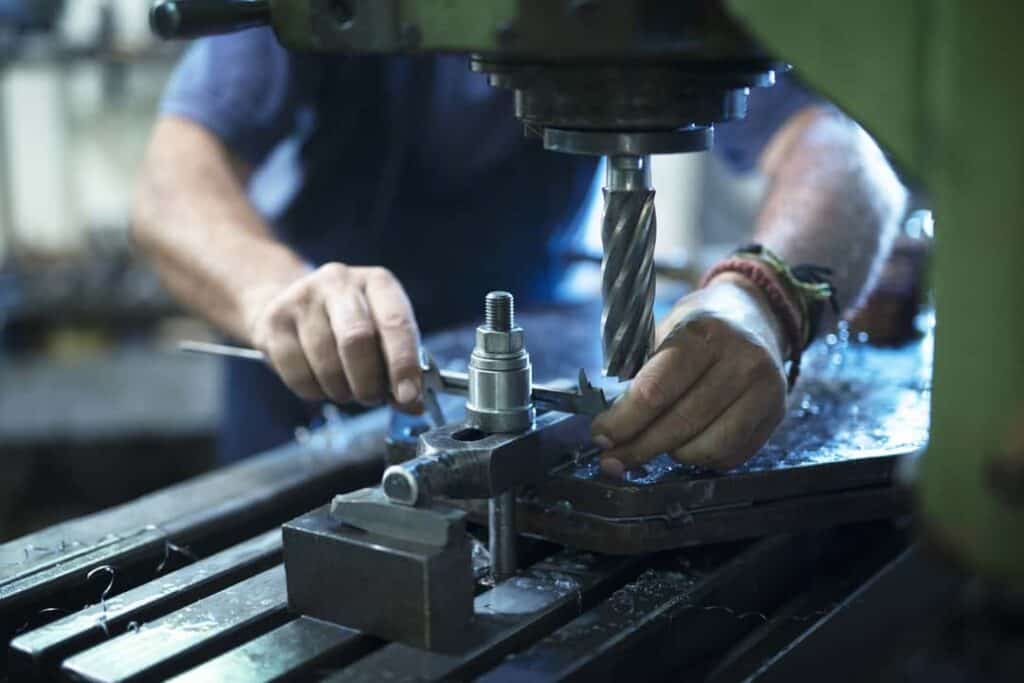
If you've ever held a precision-machined part, a shaft, a bracket, a threaded fastener — and thought, "I wonder how this thing actually gets made," you're in the right place. CNC milling and turning are the two workhorses behind almost every precision component manufactured today. Together, they cover an enormous range of shapes, materials, and tolerances. Separately, each has a job that it does better than anything else on the shop floor.
At Shamrock Precision, we've been manufacturing complex CNC-machined components since 1981, aerospace parts, defense components, and medical hardware, and one question comes up constantly from engineers and procurement teams alike: "When do I use turning, and when do I use milling?" This guide answers that. Completely.
By the end, you'll know exactly how each process works, what parts each one is built for, where they overlap, and how experienced manufacturers combine them to hit tolerances and production targets that neither process could achieve alone.
| Quick answer (if you're in a hurry):
CNC turning rotates the workpiece to create cylindrical shapes. CNC milling rotates the cutting tool to create flat surfaces, pockets, and complex 3D geometries. Most sophisticated components require both. |
What Is CNC Turning?
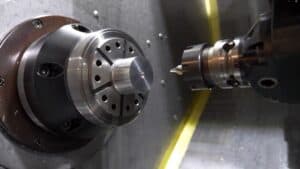
CNC turning is a subtractive machining process in which the workpiece — a raw bar or billet of metal — is clamped in a chuck and spun at high speed on a lathe. A stationary cutting tool is then fed into the rotating material, peeling away everything that doesn't belong until you're left with the part you designed.
The "CNC" part — Computer Numerical Control — means none of that tool movement is guesswork. Every feed rate, depth of cut, and toolpath is programmed precisely, so whether you're making one part or ten thousand, the CNC turning machine process produces identical results every time.
What CNC Turning Excels At
Turning is purpose-built for round, cylindrical, and symmetric parts. If a cross-section of your component looks like a circle, turning is almost certainly part of its manufacturing process. Common applications include:
- Shafts and spindles (often found in aerospace machining applications)
- Threaded fasteners, bolts, and studs
- Bushings, sleeves, and bearing housings
- Pins, dowels, and axles
- Hydraulic and pneumatic valve bodies
- Custom shear screws and precision fasteners
The CNC turning workpiece setup is deceptively simple: secure the material, spin it, and apply a sharp cutting edge. But achieving tolerances of ±0.001" consistently across a production run — that's where skill, tooling selection, and machine calibration separate good shops from great ones.
Key Components of a CNC Turning Machine
- Spindle & chuck: Holds and rotates the workpiece at programmed RPM
- Tool turret: Houses multiple cutting tools that index automatically between operations
- Tailstock: Supports long workpieces to prevent deflection during cutting
- CNC controller: Executes the G-code program that drives all motion
What Is a CNC Milling Machine?
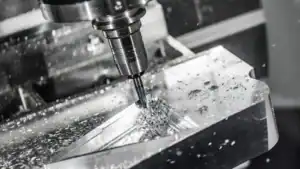
Where turning spins the part, CNC milling does the opposite: the workpiece sits still (or moves in controlled linear paths) while a rotating multi-tooth cutter removes material. This distinction matters enormously because it's what gives milling its versatility.
A CNC milling machine moves its cutter along multiple axes — typically X, Y, and Z, and often a 4th or 5th rotational axis on advanced machines. That multi-axis freedom is why precision CNC milling can produce shapes that would be impossible on a lathe: complex contours, angled surfaces, internal pockets, and three-dimensional profiles.
Curious about what's possible? Our CNC milling services page shows the specific materials, tolerances, and part types we handle on a daily basis.
What CNC Milling Excels At
Milling is the go-to for anything that isn't round. Its ability to move cutters along multiple simultaneous axes makes it ideal for:
- Flat and contoured surfaces
- Pockets, slots, and grooves
- Complex 3D geometries (aerospace structural parts, mold cavities)
- Angled and compound features
- Gear teeth and splines
- Precision machining components with tight positional tolerances across multiple features
CNC Milling Machine Introduction: The Key Components
- Spindle: Rotates the cutting tool — not the part
- Worktable: Holds the workpiece; moves in X and Y; sometimes tilts on 5-axis machines
- Column and knee: Provide the Z-axis (vertical) movement
- Tool changer (ATC): Swaps tools automatically mid-program, critical for complex CNC machining with multiple features
- CNC controller: Interprets the CAM-generated toolpath program
CNC Milling vs CNC Turning: The Definitive Comparison
This is the question every engineer eventually asks. The short answer: it depends on the shape of your part. The longer answer is in the table below, and it's worth reading if you're making decisions about precision machining process selection.
| Feature | CNC Turning | CNC Milling |
| Primary motion | Workpiece rotates | Cutter rotates |
| Best shape output | Cylindrical / round | Flat, angular, complex 3D |
| Typical parts | Shafts, bolts, bushings | Brackets, housings, molds |
| Axis range | 2–4 axes | 3–5 axes |
| Tolerances | ±0.001" achievable | ±0.001" achievable |
| Volume sweet spot | High-volume round parts | Low-to-medium complex parts |
| Setup time | Generally faster | More setup, more flexibility |
| Aerospace use | Fasteners, pins, shafts | Structural brackets, panels |
Reading that table, a pattern emerges. Turning and milling aren't competing technologies — they're complementary ones. Most complex precision parts go through both. A turned shaft might get milled keyways. A milled housing might have turned bores. The machines work best as a team.
How Each Process Works: Step by Step
The CNC Turning Process — From Bar Stock to Finished Part
- Step 1 — Program: A CAM system generates G-code toolpaths from the CAD model
- Step 2 — Setup: Raw bar stock is loaded into the chuck; tooling is confirmed in the turret
- Step 3 — Roughing: Large cuts remove bulk material quickly — speed over precision at this stage
- Step 4 — Finishing: Light cuts with sharp tooling bring the part to its final diameter and surface finish
- Step 5 — Secondary operations: Threading, grooving, parting-off — all handled in the same setup on modern turn-mill centers
- Step 6 — Inspection: CMM or gauge verification confirms tolerances before parts leave the machine
The beauty of modern CNC turning and machining is that many secondary operations, such as drilling axial holes, milling flats, and cutting splines, can happen in a single setup on a turn-mill center. Fewer setups mean fewer opportunities for error and faster throughput.
The CNC Milling Process — From Billet to Complex Geometry
- Step 1 — Programming: CAM software generates 3D toolpaths; complex parts may have dozens of individual operations
- Step 2 — Fixturing: The workpiece is clamped to the table or held in a precision vise; fixturing quality directly affects tolerances
- Step 3 — Roughing: High-speed material removal with large-diameter end mills
- Step 4 — Semi-finishing: Removes the roughing scallops; brings the part close to the final dimension
- Step 5 — Finishing passes: Fine stepover, high RPM, sharp tooling — this is where surface finish is made or broken
- Step 6 — Inspection and validation: Our precision inspection services and precision testing processes ensure every feature meets print
When Neither Turning Nor Milling Is Enough: Swiss Machining
For very small, very precise, very complex parts, think medical components with sub-millimeter features and tolerances measured in tenths, standard turning and milling sometimes hit their practical limits. That's where Swiss machining comes in.
Swiss-style lathes guide the workpiece through a sliding headstock, keeping the material supported right at the cutting zone. The result: dramatically reduced deflection, exceptional surface finishes, and the ability to machine long, slender parts that would chatter into scrap on a conventional lathe. If your part has a high length-to-diameter ratio, Swiss machining deserves a serious look.
How to Choose Between CNC Milling and Turning (A Practical Framework)
Here's a decision process that experienced manufacturing engineers actually use, not a flowchart from a textbook, but the real questions that guide process selection:
1. What does the part's cross-section look like?
Circular or near-circular: turning is your starting point. Angular, flat, or irregular: start with milling. Most parts have both; start with whichever process creates the datum features your fixturing will use for the other.
2. What tolerances are required?
Both processes can achieve ±0.001" routinely. Below that, you're in grinding or honing territory — but both turning and milling can hold ±0.0005" in controlled conditions on a well-maintained machine. The question isn't "which process is more precise" — it's "which process is more precise for this particular feature."
3. What material are you machining?
Aluminum, titanium, stainless steel, Inconel, hardened tool steel, each material has preferred cutting speeds, feeds, and tooling for both turning and milling. The precision turning manufacturing world has extensive data on optimal parameters; a good shop will choose tooling based on material machinability, not convenience.
4. How many parts do you need?
High-volume production of round parts (thousands of identical shafts, for example) heavily favors turning — bar-fed, automated, fast. Complex CNC machining of low-to-medium volumes of intricate parts favors milling. And for one-off prototypes, milling is usually faster to set up because fixturing is simpler.
5. Can hybrid machining reduce setups?
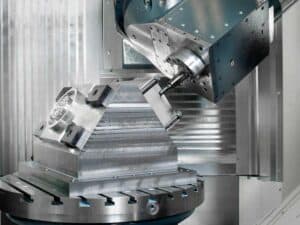
This is the question most engineers don't ask but should. Modern turn-mill centers combine both capabilities in one machine. If your part needs both round features (turned) and flat/complex features (milled), a turn-mill center can do everything in one setup, eliminating re-chucking error and slashing lead time. Our machining capabilities include these hybrid operations for exactly this reason.
| Real-world example:
An aerospace hydraulic manifold requires a turned bore for sealing, milled port faces for O-ring grooves, and drilled cross-passages. Three processes, one part, and ideally handled in as few setups as possible by a manufacturer with the equipment and programming experience to do it right. |
Tolerances, Materials, and What 'Precision' Actually Means
The word "precision" gets thrown around casually in machining. Let's be specific. In the context of CNC precision turning technology and high precision milling and turning, precision has a measurable definition.
What tolerances are achievable?
- Standard production turning and milling: ±0.002" to ±0.005"
- Precision machining: ±0.001" (one-thousandth of an inch)
- High-precision / optical: ±0.0005" or better
- Grinding required below: ±0.0002"
For reference, a human hair is about 0.003" thick. Precision-machined components regularly hold tolerances tighter than that across complex, multi-feature parts, which is why basic precision machining technology depends on temperature-controlled shops, calibrated measurement equipment, and experienced machinists who understand how materials behave as they're cut.
Common materials for CNC milling and turning
- Aluminum alloys (6061, 7075) — fast to machine, excellent strength-to-weight, dominant in aerospace
- Stainless steel (303, 304, 316, 17-4 PH) — corrosion resistance, common in medical and marine applications
- Titanium — exceptional strength-to-weight, notoriously difficult to machine; requires specific tooling and conservative parameters
- Inconel and nickel alloys — extreme heat resistance; common in jet engine components
- Tool steel and hardened steels — mold components, cutting tools, high-wear applications
- Brass and copper — electrical components, plumbing, decorative hardware
- Engineering plastics (Delrin, PEEK, nylon) — lightweight, chemically resistant, medical-grade applications
Material selection affects the entire CNC machining precision manufacturing process, from spindle speeds and feed rates to cutting fluid selection and tooling life. Our team evaluates material and geometry together when quoting a job, because the interaction between them determines cost and lead time.
Industries That Depend on CNC Milling and Turning
Precision machining components made through CNC turning and milling end up in industries where failure isn't an option. That's not marketing language, it's a statement about the quality standards these sectors enforce, and why certifications like ISO 9001 and AS9100 exist.
Aerospace and Defense
Structural brackets, flight control components, hydraulic manifolds, landing gear parts, aerospace machining demands the tightest tolerances, the most demanding materials, and full traceability from raw material to finished part. AS9100 certification governs this work.
Medical and Surgical
Surgical instruments, implant components, diagnostic device housings, and medical machining combine extreme precision with biocompatibility requirements. Surface finish isn't just aesthetic; it affects sterilization and tissue interaction.
Industrial Automation and Energy
Pump housings, valve bodies, motor shafts, gearbox components — these applications demand consistency at scale. A shaft that's 0.003" undersized might work fine in testing, but cause premature bearing failure after 10,000 hours in the field. Precise turning and manufacturing at volume is where experience and process control matter most.
Electronics and Semiconductor
Enclosures, heat sinks, fixture plates, test equipment components, often aluminum, often requiring tight flatness and positional tolerances to interface with circuit boards and sensitive equipment.
Beyond the Machine: What Happens After Turning and Milling
Machining is rarely the last step. Most finished components go through additional processes before they're ready for assembly or delivery. Good manufacturers don't just run machines — they manage the entire production chain. That's what our outside process management services handle: coordinating heat treatment, anodizing, plating, passivation, and other secondary processes so you get a complete, ready-to-install part.
Common post-machining processes include:
- Heat treatment (stress relieving, hardening, annealing)
- Surface finishing (anodizing, chrome plating, electroless nickel, black oxide)
- Grinding and lapping (for surfaces requiring sub-thousandth tolerances)
- Cleaning, passivation, and chemical treatment
- Dimensional and cosmetic inspection to drawing requirements
Frequently Asked Questions
What is CNC turning?
CNC turning is a machining process where a workpiece rotates on a lathe spindle while a stationary cutting tool removes material to create cylindrical shapes. The CNC (Computer Numerical Control) system automates all tool movements based on a programmed set of instructions. It's used for shafts, bolts, bushings, and any component with a round cross-section. See our dedicated CNC turning services page for specifics.
What is a CNC milling machine?
A CNC milling machine is a cutting machine where rotating multi-tooth cutters remove material from a stationary (or slowly moving) workpiece. Unlike a lathe, the cutter moves — not the part — allowing the machine to create flat surfaces, angled features, pockets, and complex 3D geometries. Modern CNC mills operate on 3, 4, or 5 axes simultaneously.
What is the difference between CNC milling and turning?
The core difference: in turning, the workpiece rotates; in milling, the cutting tool rotates. This fundamental distinction determines what shapes each process can produce. Turning creates cylindrical and symmetric shapes. Milling creates flat surfaces, pockets, contours, and complex geometries. Most sophisticated parts require both. The comparison table earlier in this guide covers the key differences in tolerances, applications, and volume suitability.
What is CNC milling and turning used for?
CNC milling and turning together cover the manufacturing of virtually every precision metal component. Turning handles, shafts, fasteners, pins, bushings, and round components. Milling handles brackets, housings, plates, molds, and anything with complex geometry. Used in combination, they can produce nearly any component design a CAD file can describe.
How does CNC milling differ from CNC turning in terms of motion?
In CNC turning, the primary motion is the rotation of the workpiece — the part spins, and the tool is fed into it. In CNC milling, the primary motion is the rotation of the cutter — the tool spins and moves along programmed paths. This difference in motion drives everything else: the geometries each process can produce, the fixturing required, and the types of features that are natural vs. difficult for each machine.
What is CNC precision machining?
CNC precision machining is the production of components to tight dimensional tolerances — typically ±0.001" or better — using computer-controlled cutting machines. "Precision" distinguishes this work from general machining by the measurement and process control standards applied. Precision machining manufacturers like Shamrock Precision operate ISO 9001 and AS9100-certified quality systems to ensure every part meets drawing requirements.
What is a CNC turning machine?
A CNC turning machine — also called a CNC lathe — is a machine tool that rotates a workpiece against a cutting tool to remove material. Modern CNC lathes can perform turning, drilling, threading, and (on turn-mill centers) milling operations in a single setup. They range from simple 2-axis lathes to complex multi-spindle, multi-turret machines capable of producing finished parts in seconds.
What is a CNC milling machine used for?
CNC milling machines are used to create parts with flat surfaces, pockets, slots, contours, and complex 3D geometries. Applications span aerospace structural components, medical device housings, mold cavities, gearbox housings, electronic enclosures, and custom fixtures. Essentially, if a part isn't round, a mill probably touched it.
How to use a CNC milling machine?
Using a CNC milling machine involves five core steps:
(1) CAD modeling of the part
(2) CAM programming to generate toolpaths
(3) workholding setup — fixturing the blank securely to the table
(4) tool selection and loading into the ATC
(5) running the program with appropriate feeds, speeds, and cutting fluid.
For production runs, step 3 is usually the most time-intensive — good fixturing is the difference between a 0.001" part and a scrapped one.
What are the main CNC turning applications?
The most common CNC turning applications include: shafts and spindles for rotating machinery; threaded fasteners (bolts, studs, nuts); bushings and bearing housings; hydraulic valve bodies; surgical instrument handles; custom pins, dowels, and spacers; and aerospace components like landing gear pins and structural fasteners. Any application requiring tight concentricity or cylindrical symmetry is a natural fit for turning.
How does the CNC turning machine process work step by step?
The CNC turning machine process follows this sequence: raw material (bar stock or billet) is loaded and chucked; the CNC program is loaded and verified; the machine executes roughing passes to remove bulk material; finishing passes refine the diameter and surface finish; secondary operations (threading, grooving, undercutting) are performed with indexed tools; the finished part is parted off or removed; and inspection confirms all dimensions are within tolerance. On automated bar-fed lathes, this cycle repeats continuously without operator intervention.
Ready to Machine Your Next Part?
Understanding CNC milling and turning is step one. Finding a manufacturer who can execute both — to tight tolerances, on time, with full quality documentation — is step two. Shamrock Precision has been doing exactly that since 1981, serving aerospace, defense, and industrial customers with ISO 9001 and AS9100 certified processes.
Whether your next project needs precision turning, milling, Swiss machining, or a combination of all three, our team will review your drawings, identify the optimal process approach, and provide a quote that reflects real manufacturing experience — not a number from a spreadsheet.
Explore our full machining capabilities or contact us directly to discuss your project. We're in Dallas, TX — and we've shipped precision components to customers worldwide.