
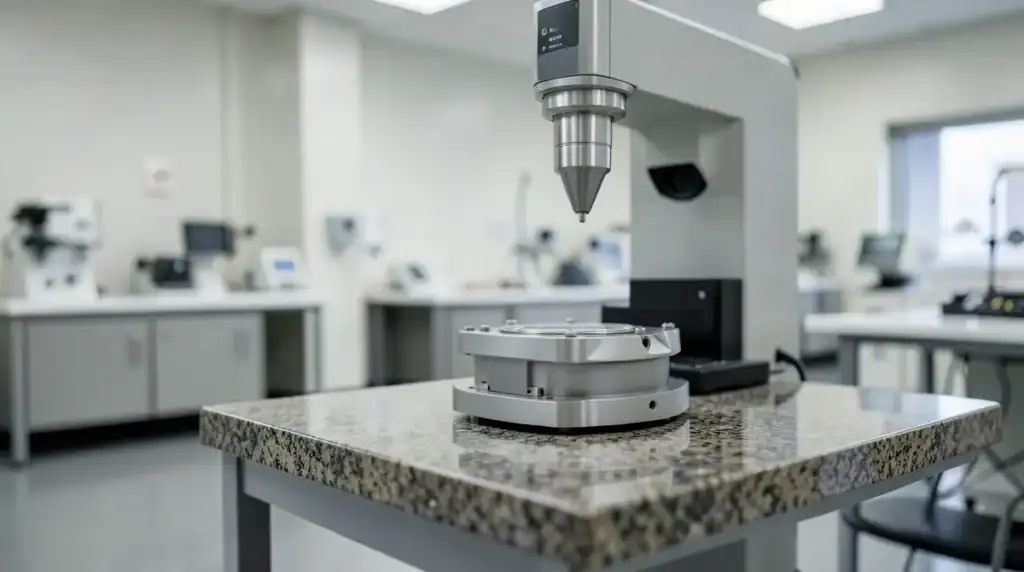
An AS9102 first article inspection is a documented check that a new production process makes a part that conforms to its drawing and specifications. The report that comes out of it, the first article inspection report or FAIR, is the record a buyer reviews before accepting production from a new source or a changed process.
Which revision of AS9102 is current?
SAE International lists AS9102C as the current revision, dated June 28, 2023. The standard was first issued in August 2000. It sets the requirements for performing and documenting a first article inspection.
SAE notes that those requirements add to customer and regulatory requirements rather than replacing them. In practice, that means a purchase order can ask for more than the standard does, and the supplier is held to both.
Why do aerospace buyers require a FAIR from suppliers?
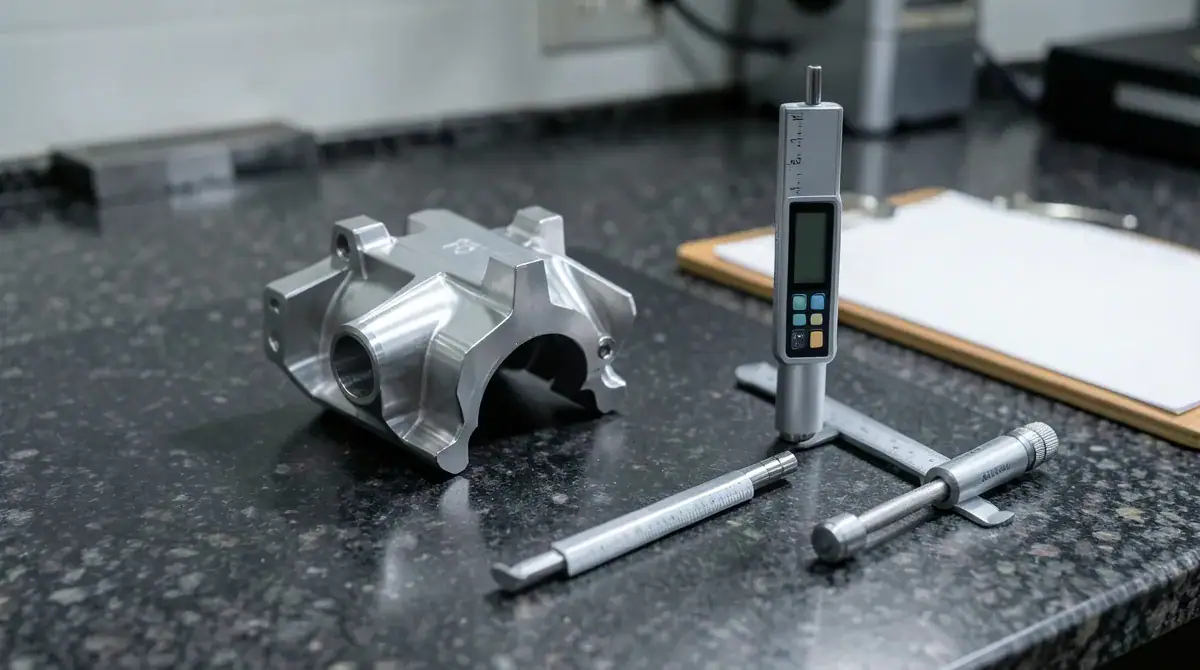
The answer sits in how responsibility is assigned. An FAA production approval holder stays responsible for the conformity of every part it ships, including parts made by its suppliers. The first article report is one of the ways that holder confirms a supplier’s process before relying on it. Traceability carries the same logic through the rest of production, which our pillar article on aerospace part traceability covers in detail.
When does FAA guidance call for a first article inspection?
FAA Advisory Circular 21-43A, dated October 1, 2015, gives production approval holders guidance on controlling their suppliers. Three of its points bear on first article work:
- Supplier verification. The AC lists first article inspection among the methods for verifying that a supplier’s article conforms to approved data.
- New production lines. The AC states that a first article inspection should be conducted for a new production line.
- AS9102 as the reference. The AC points to SAE AS9102 (Revision A, current when the AC was issued) as guidance for setting up first article processes and procedures.
The same AC states that the holder’s responsibility for conformity cannot be delegated to suppliers. It also lists special process certifications among the records a holder should retain. Outside processes such as heat treat and plating are audited under their own system, which our comparison of Nadcap special processes and AS9100 explains.
What does a FAIR show the buyer?
A FAIR ties a measured result to each characteristic on the drawing, so the reviewer can see that each requirement was checked and what the result was. Key or critical characteristics are typically flagged so they get closer review. Buyers usually read the FAIR alongside the material certifications and outside process records for the same part.
What should an RFQ say when a FAIR is required?
A first article requirement adds inspection and documentation time to the first run. Stating it in the RFQ lets the quote reflect that work from the start. Items worth stating up front:
- That a FAIR to AS9102 is required, and which revision the customer expects
- Who reviews and approves the FAIR, and whether the customer wants to witness any of it
- Which characteristics the customer treats as key or critical
- The format the customer wants the report delivered in
Shamrock Precision states that it provides First Article Inspection Reports in accordance with AS9102, and that its test documentation packages include measured values and calibration certificates traceable to NIST standards.
Frequently Asked Questions About AS9102 First Article Inspection
01What is the current revision of AS9102?
AS9102C is the current revision of the aerospace first article inspection standard, dated June 28, 2023, according to SAE International. The standard was first issued in August 2000. AS9102C sets the requirements for performing a first article inspection and for documenting the results in a first article inspection report.
02What is a FAIR in aerospace manufacturing?
A FAIR, or first article inspection report, is the document produced by a first article inspection. A FAIR ties a measured result to each characteristic on the drawing, so a reviewer can confirm each requirement was checked before the customer accepts production from a new source or a changed process.
03When is a first article inspection required?
FAA Advisory Circular 21-43A states that a first article inspection should be conducted for a new production line, and lists first article inspection among the methods for verifying that supplier articles conform to approved data. Customer purchase orders can set additional triggers for a new or partial first article inspection.
04Does AS9102 replace customer requirements?
No. SAE International states that AS9102 requirements are complementary to customer and regulatory requirements, not an alternative to them. A purchase order can require more than the AS9102 standard does, and a supplier performing a first article inspection is expected to meet both the standard and the customer’s own terms.
05Does Shamrock Precision provide AS9102 first article inspection reports?
Shamrock Precision, an ISO 9001 and AS9100 certified CNC machine shop in Dallas, Texas, states that it provides First Article Inspection Reports in accordance with AS9102. Shamrock also states that its test documentation packages include measured values and calibration certificates traceable to NIST standards.
Shamrock Precision: ISO 9001 and AS9100 Certified Machining in Dallas
Shamrock Precision has machined precision components since 1981 from Dallas, Texas. The shop is ISO 9001 and AS9100 certified, with Swiss machining, milling, turning, and inspection under one quality system.
Our Services Include:
- Precision Testing: Dimensional, material, and functional testing with documentation that includes measured values
- Precision Inspection Services: In-process and final inspection with the documentation aerospace programs require
Qualifying a new supplier? Request a quote with your print, material, and quantity.
Works Cited
- “AS9102C: Aerospace Series First Article Inspection Requirements.” SAE International, 28 June 2023, saemobilus.sae.org/standards/as9102c-aerospace-series-first-article-inspection-requirements. Accessed 29 Oct. 2026.
- “Advisory Circular 21-43A: Production Under 14 CFR Part 21, Subparts F, G, K, and O.” Federal Aviation Administration, 1 Oct. 2015, www.faa.gov/documentLibrary/media/Advisory_Circular/AC_21-43A.pdf. Accessed 29 Oct. 2026.