

Computer Numerical Control (CNC) turning has revolutionized the manufacturing industry, offering unparalleled precision, efficiency, and versatility in the production of cylindrical parts. At Shamrock Precision, we specialize in CNC Turning Across Industries, delivering the high-tolerance components essential for today’s most demanding sectors. At Shamrock Precision, we have embraced precision machining technology to deliver exceptional quality and innovation to our customers across various industries. This blog post will delve into the intricacies of CNC turning, exploring its capabilities, applications, and the cutting-edge technology that drives modern turning centers.
Understanding CNC Turning
CNC turning is a subtractive manufacturing process that involves the use of computer-controlled lathes to create cylindrical parts with high precision. Unlike traditional manual lathes, CNC turning centers can produce complex geometries with minimal human intervention, ensuring consistency and accuracy across large production runs.
Key Components of a CNC Turning Center
- Main Spindle: Holds and rotates the workpiece
- Turret: Houses multiple cutting tools for various operations
- Sub-Spindle: Enables back-end machining and part transfer
- CNC Controller: The "brain" of the machine, executing programmed instructions
The Evolution of CNC Turning
The journey from manual lathes to modern CNC turning centers spans several decades of technological advancement:
- 1950s: Introduction of numerical control (NC) machines
- 1960s-1970s: Development of computer numerical control (CNC)
- 1980s-1990s: Integration of CAD/CAM systems with CNC machines
- 2000s-Present: Multi-axis capabilities, live tooling, and advanced automation
Shamrock Precision's Turning Capabilities
At Shamrock Precision, we pride ourselves on our state-of-the-art CNC turning capabilities — complemented by our Swiss machining services for small-diameter, high-volume precision parts:
4-Axis Milling/Turning
Our 4-axis milling/turning centers can handle workpieces up to 8" in diameter on the main spindle and 6" on the sub-spindle. This configuration allows for:
- Complex contouring
- Off-center drilling and milling
- Simultaneous machining on multiple surfaces
7-Axis CNC Lathes
For even more complex parts, our 7-axis CNC lathes can accommodate diameters up to 18". The additional axes provide:
- Enhanced flexibility in part positioning
- Ability to machine complex geometries in a single setup
- Reduced cycle times and improved accuracy
High-Performance Turning Centers
Our investment in cutting-edge technology is reflected in our diverse range of turning centers:
- (4) Mazak QT 100S: Capable of handling parts up to 1.625" in diameter
- (2) Mazak QT Nexus 100M: Also accommodating 1.625" diameter workpieces
- (5) Mazak QT Nexus 250: Handling larger parts up to 8.00" in diameter
- Okuma LB3000 MYW: A 4-axis machine with 8.00" main spindle and 6.00" sub-spindle capacity
- Okuma Multus U3000: Our 7-axis powerhouse, capable of turning parts up to 18.00" in diameter
Advantages of CNC Turning
CNC turning offers numerous benefits over traditional machining methods:
Precision and Accuracy
Modern CNC turning centers can achieve tolerances as tight as ±0.0001 inches, ensuring consistent quality across large production runs.
Complexity of Parts
With multi-axis capabilities and live tooling, CNC turning can produce parts with intricate features that would be impossible or impractical with manual methods.
Efficiency and Productivity
Automated tool changes, simultaneous operations, and minimal setup times significantly reduce production cycles, increasing overall efficiency.
Repeatability
Once programmed, CNC machines can reproduce identical parts with high consistency, making them ideal for high-volume production.
Material Versatility
CNC turning centers can work with a wide range of materials, from soft plastics to hardened steels and exotic alloys.
Applications Across Industries
Shamrock Precision's CNC turning services cater to diverse industries:
Energy Sector
In the energy industry, we produce:
- Precision valve components for oil and gas applications
- Turbine parts for renewable energy systems
- High-pressure fittings for hydraulic systems
- Shear crews for downhole drilling safety applications.
Medical Industry
Our CNC turning expertise contributes to the medical field through:
- Implant components with biocompatible materials
- Surgical instrument parts requiring high precision
- Custom fixtures for medical devices
Electronics
For the electronics industry, we manufacture:
- Precision housings for sensitive components
- Heat sinks for thermal management
- Connectors and interface components
Aerospace
Through our aerospace machining capabilities, our clients rely on us for:
- Engine components with tight tolerances
- Structural elements for aircraft assemblies
- Fasteners and fittings for critical systems
Defense
In the defense sector, we produce:
- Components for advanced weapons systems
- Precision parts for communication devices
- Specialized fittings for military vehicles
The CNC Turning Process
Understanding the CNC turning process is crucial to appreciating its complexity and capabilities:
1. Design and Programming
The process begins with a 3D CAD model of the part, which is then translated into G-code instructions for the CNC machine using CAM software.
2. Setup and Tool Selection
The workpiece is mounted in the chuck or collet, and the appropriate cutting tools are loaded into the turret.
3. Machining Operations
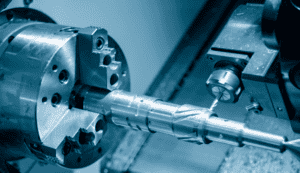
Common operations in CNC turning include:
- Facing: Creating flat surfaces perpendicular to the rotation axis
- Turning: Reducing the diameter of the workpiece
- Boring: Creating or enlarging internal diameters
- Threading: Cutting internal or external threads
- Grooving: Creating recesses or undercuts
4. In-Process Measurement
Many modern CNC turning centers incorporate in-process measurement systems to ensure dimensional accuracy throughout the machining process.
5. Finishing
Final operations, managed through our outside process management services, may include deburring, polishing, or surface treatments to achieve the desired finish and tolerances.
Advanced Features of Modern CNC Turning Centers
Live Tooling
Live tooling allows for milling and drilling operations on a turning center, reducing the need for secondary operations and improving overall efficiency.
Sub-Spindle Technology
Sub-spindles enable complete machining of both ends of a part in a single setup, significantly reducing handling and improving accuracy.
Automated Tool Monitoring
Advanced tool monitoring systems can detect tool wear and breakage in real-time, preventing defects and minimizing downtime.
Thermal Compensation
To maintain precision in varying temperature conditions, many CNC turning centers incorporate thermal compensation algorithms.
Quality Assurance in CNC Turning
Quality is paramount in our CNC turning operations:
Rigorous Inspection Processes
Our precision inspection services employ state-of-the-art coordinate measuring machines (CMMs) and optical inspection systems to verify part dimensions and surface quality.
Statistical Process Control (SPC)
By implementing SPC techniques alongside precision testing protocols, we continuously monitor and improve our machining processes to ensure consistent quality.
Material Traceability
Our robust material management system ensures full traceability from raw material to finished product, critical for industries with stringent documentation requirements.
Future Trends in CNC Turning
As technology continues to advance, several trends are shaping the future of CNC turning:
Artificial Intelligence and Machine Learning
AI algorithms are being integrated into CNC controllers to optimize cutting parameters, predict maintenance needs, and improve overall efficiency.
Additive-Subtractive Hybrid Machines
Some manufacturers are exploring the integration of additive manufacturing capabilities with traditional CNC turning, opening new possibilities for complex part production.
Sustainable Manufacturing
The focus on sustainability is driving the development of more energy-efficient machines and the implementation of minimum quantity lubrication (MQL) systems to reduce environmental impact.
Conclusion
CNC turning represents the pinnacle of precision manufacturing, offering unparalleled capabilities in the production of cylindrical parts. At Shamrock Precision, we harness the power of advanced CNC turning centers to deliver exceptional quality and innovation.
From intricate medical components to robust aerospace parts, our CNC turning expertise enables us to meet the most demanding manufacturing challenges. As we continue to invest in cutting-edge technology and cultivate our skilled workforce, we remain committed to pushing the boundaries of what's possible in CNC turning.
Whether you need high-volume production runs or custom prototypes, Shamrock Precision's CNC turning capabilities are ready to transform your designs into reality. Contact our team today to discover how our expertise in CNC turning can elevate your manufacturing processes and deliver the precision components your projects demand.
FAQs
Q1: What is CNC turning, and how does it work?
CNC turning is a subtractive manufacturing process where a computer-controlled lathe rotates the workpiece while a stationary cutting tool removes material to create cylindrical parts. The CNC controller executes programmed G-code instructions to control tool position, feed rate, and spindle speed — delivering consistent, high-precision results across large production runs.
Q2: What tolerances can CNC turning achieve?
Modern CNC turning centers can achieve tolerances as tight as ±0.0001 inches, making the process suitable for the most demanding applications in aerospace, medical, and defense manufacturing, where dimensional accuracy is non-negotiable.
Q3: What is the difference between CNC turning and CNC milling?
CNC turning rotates the workpiece against a stationary cutting tool to produce cylindrical or conical shapes — ideal for shafts, bushings, and fittings. CNC milling holds the workpiece stationary while rotating cutting tools remove material to produce flat surfaces, slots, and complex contours. Many modern turning centers include live tooling that performs milling operations without a separate machine setup.
Q4: What industries use CNC turning the most?
CNC turning serves a broad range of industries, including aerospace (engine components and fasteners), medical (implant parts and surgical instruments), energy (valve bodies and high-pressure fittings), electronics (precision housings and connectors), automotive (transmission parts), and defense (communication device components and specialized fittings).
Q5: What is live tooling on a CNC turning center?
Live tooling refers to powered rotating tools mounted in the turret of a CNC turning center that can perform milling, drilling, and threading operations while the workpiece is held in the chuck. This eliminates the need for secondary operations on a separate milling machine, reducing cycle time, handling, and the potential for dimensional error between setups.
Q6: What is a sub-spindle in CNC turning?
A sub-spindle is a second spindle positioned opposite the main spindle on a CNC turning center. It accepts the partially machined part directly from the main spindle, allowing complete front-to-back machining in a single cycle without manual part flipping. This improves accuracy, reduces handling time, and is essential for high-volume production of parts requiring operations on both ends.
Q7: What materials can be machined with CNC turning?
CNC turning centers can process a wide range of materials, including aluminum, stainless steel, carbon steel, titanium, Inconel, brass, copper, and engineering plastics. Material selection depends on the application's requirements for strength, corrosion resistance, thermal stability, and machinability.
Q8: How does multi-axis CNC turning improve part production?
Multi-axis CNC turning — from 4-axis to 7-axis configurations — allows the cutting tool and workpiece to move simultaneously along multiple planes. This enables the machining of complex geometries, angled features, and undercuts in a single setup, reducing cycle time, minimizing part handling, and improving dimensional accuracy compared to sequential single-axis operations.
Q9: How is quality controlled in CNC turning operations?
Quality in CNC turning is maintained through in-process measurement systems, coordinate measuring machines (CMMs), optical inspection tools, and Statistical Process Control (SPC) techniques. Certifications such as ISO 9001 and AS9100 provide a framework for documented quality management, material traceability, and continuous process improvement.
Q10: What should I look for when choosing a CNC turning service provider?
Key factors include the provider's range of turning equipment (axis count, spindle diameter capacity), material handling expertise, quality certifications (ISO 9001, AS9100), in-process inspection capabilities, lead times, and experience in your specific industry. Providers who invest in multi-axis turning centers and maintain rigorous quality systems are best positioned to deliver tight-tolerance components reliably.