
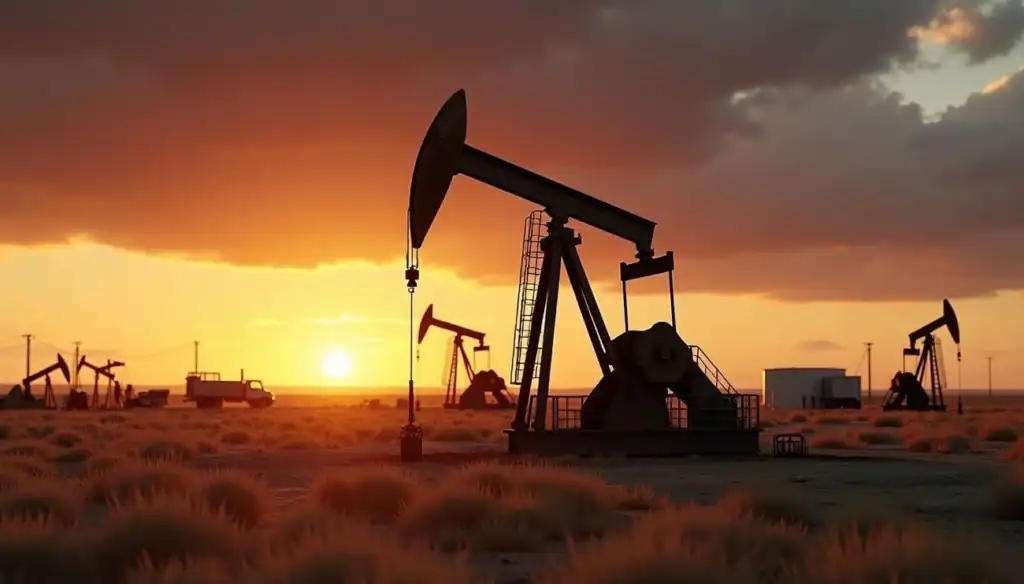
Texas oil and gas producers entered 2025 expecting a favorable regulatory environment and renewed federal support for domestic energy production. Instead, the industry confronts a challenging convergence of steel tariffs, volatile commodity prices, and elevated uncertainty that is fundamentally altering drilling economics across the Permian Basin and beyond. This climate has highlighted the need for precision machining to ensure operational efficiency amidst rising costs. The disconnect between political rhetoric about energy dominance and the operational reality facing Texas oil producers has created planning paralysis at precisely the moment when capital allocation decisions matter most.
The second quarter of 2025 brought sobering data from the Federal Reserve Bank of Dallas, whose quarterly Energy Survey revealed that business activity in the oil and gas sector contracted for the first time since the pandemic recovery. The business activity index, the survey's broadest measure of conditions facing energy firms in the Eleventh Federal Reserve District, dropped to negative 8.1 in the second quarter from positive 3.8 in the first quarter. This swing into negative territory signals that more firms are experiencing deteriorating conditions, a reversal that often forces operators to seek more efficient CNC turning services and automated solutions to maintain their margins.
The implications extend far beyond quarterly statistics. When nearly half of exploration and production executives report plans to drill fewer wells than anticipated at the start of the year, the ripple effects cascade through equipment suppliers, service companies, and the communities that depend on drilling activity for economic vitality.
Steel Tariffs Squeeze Already Tight Margins
The recent increase in steel import tariffs from 25 percent to 50 percent has imposed direct cost burdens on Texas oil producers at a time when commodity prices offer little cushion. According to the Federal Reserve Bank of Dallas Energy Survey, executives report that tariffs have increased drilling and completion costs by 4 to 10 percent, with some smaller operators experiencing even larger impacts. The most common response among surveyed executives indicated cost increases in the 4 to 6 percent range, though 12 percent of respondents reported increases between 8 and 10 percent.
These percentages translate into substantial dollar figures when applied to wells that can cost several million dollars to drill and complete. To combat these rising material costs, many operators are looking toward specialized Swiss machining services to produce high-tolerance, small-diameter components that reduce waste and improve tool longevity. One survey respondent captured the frustration shared by many, noting that the administration's tariffs immediately increased casing and tubing costs by 25 percent, even on inventory that cost suppliers far less to acquire.
The tariff impact falls unevenly across the industry. Larger producers with established supplier relationships and the ability to lock in pricing through long-term contracts report smaller cost increases than smaller independents who purchase materials on spot markets. This disparity threatens to accelerate consolidation trends that have already reshaped the Texas oil patch over the past several years, potentially squeezing out the smaller operators who have historically driven innovation and maintained competitive pressure on service costs.
Understanding how equipment reliability factors into these cost pressures becomes essential when margins tighten. Exploring [Equipment Failures Cost Texas Drilling Operations Millions – The Critical Role of Precision Safety Components] reveals why component quality matters more than ever when every drilling dollar must deliver maximum value.
Production Records Mask Underlying Stress
The apparent contradiction between record production levels and industry pessimism reflects the complex dynamics shaping Texas energy markets in 2025. The U.S. Energy Information Administration reports that domestic crude oil production reached 13.6 million barrels per day in July 2025, setting a new record driven primarily by continued gains in the Permian Basin. The agency forecasts production averaging 13.5 million barrels per day for the full year, demonstrating the remarkable productivity improvements that Texas operators have achieved even as rig counts decline.
This production resilience stems from efficiency gains rather than expanded activity. Operators are extracting more oil from fewer wells through optimized completion designs and advanced CNC milling services that create complex geometries for downhole tools with higher recovery rates. The EIA notes that productivity increases indicate significant efficiency gains and technological advancements in the drilling and completion process, with newly completed Permian wells producing an average of 433,000 barrels per day in their first full month of operation.
However, these efficiency gains cannot continue indefinitely without sustained capital investment. As equipment undergoes more stress, the demand for secondary operations such as heat treating and plating grows, making outside processing management a vital part of the supply chain to ensure part durability in harsh environments.
Workforce Implications of Reduced Activity
The employment consequences of reduced drilling activity are already materializing across Texas oilfield communities. While upstream employment remained relatively stable through the first half of 2025, the trajectory has shifted. Service sector employment, which accounts for the majority of oilfield jobs, proves particularly vulnerable to activity reductions as operators defer projects and renegotiate service contracts to preserve margins.
The specialized nature of oilfield work creates challenges that extend beyond simple job counts. When experienced crews disperse during downturns, reconstituting that expertise for future upturns becomes difficult and expensive. Training pipelines that took years to develop can collapse in months, creating bottlenecks that constrain activity even when commodity prices recover sufficiently to justify expanded drilling programs.
This workforce dynamic creates particular stress for equipment suppliers and service providers who must maintain capabilities through uncertain periods. Companies that maintain high-quality standards by utilizing professional CNC turning services during lean times are the ones that remain ready when activity rebounds.
Planning Paralysis Grips the Industry
Perhaps more damaging than the direct cost impacts is the uncertainty that prevents long-term planning. Survey respondents repeatedly cited unpredictability as their primary concern, noting that constant policy changes make capital allocation decisions extraordinarily difficult. One executive observed that oil prices feel incredibly unstable, making it hard to gauge whether prices will settle in the fifty-dollar or seventy-dollar per barrel range. Combined with tariff uncertainty, the ability to plan operations for any meaningful time horizon has been severely diminished.
This planning paralysis has cascading effects throughout the supply chain. Equipment manufacturers cannot commit to production schedules without visibility, yet those who leverage versatile Swiss machining services can often pivot between aerospace and energy sectors to remain stable. Service companies cannot maintain crew levels without confidence in future activity. Training programs cannot graduate new workers into an industry that may or may not need them. The result is a self-reinforcing cycle where uncertainty breeds caution, which reduces activity, which creates more uncertainty.
The efficiency imperative reshaping Texas drilling operations carries significant implications for equipment selection and maintenance practices. When examining [Permian Basin Sets Production Records Despite Declining Rig Counts – How Efficiency Gains Are Reshaping Texas Drilling], the connection between operational excellence and component reliability becomes clear.
Looking Ahead Through Uncertain Terrain
The Texas oil and gas industry has navigated volatile conditions throughout its history, and the current challenges, while significant, do not represent existential threats to operators who maintain financial discipline and operational excellence. Average respondent expectations for West Texas Intermediate crude pricing at year-end 2025 centered around sixty-eight dollars per barrel, a level that supports profitable operations for efficient producers even with elevated input costs.
The critical variable remains the duration and intensity of current pressures. Short-term disruptions allow operators to weather challenges through inventory management and deferred maintenance. Prolonged uncertainty forces more fundamental adjustments that can permanently alter industry structure and regional economic vitality. The difference between these scenarios depends heavily on policy stability and commodity market developments that remain difficult to predict.
What operators can control is their own operational excellence, including the quality of equipment and components they deploy in challenging environments. When margins compress, the reliability provided by precision manufacturing and efficient outside processing becomes a business imperative that directly impacts profitability.
Shamrock Precision: Your Partner in Texas Oil and Gas Operations
At Shamrock Precision, we have served Texas oil and gas operations for over four decades with precision-engineered components that deliver reliable performance in the most demanding environments. Our team understands that equipment quality directly impacts your operational success and bottom line.
Our Services Include:
- Shear Screws for Oil and Gas – Precision-manufactured safety components engineered to exact specifications for drilling and completion operations
- Custom Precision Manufacturing – Swiss CNC machining capabilities delivering tolerances to 0.0005 inches for critical applications
Ready to Discuss Your Requirements? Contact Shamrock Precision to learn how our four decades of manufacturing expertise can support your Texas oil and gas operations.
Works Cited
"Oil and Gas Activity Contracts Slightly as Uncertainty Remains Elevated." Federal Reserve Bank of Dallas, June 2025, www.dallasfed.org/research/surveys/des/2025/2502. Accessed 24 Nov. 2025.
"Permian Production Forecast Growth Driven by Well Productivity, Pipeline Capacity." U.S. Energy Information Administration, www.eia.gov/todayinenergy/detail.php?id=62884. Accessed 24 Nov. 2025.
Related Articles
- [Permian Basin Sets Production Records Despite Declining Rig Counts – How Efficiency Gains Are Reshaping Texas Drilling]
- [Equipment Failures Cost Texas Drilling Operations Millions – The Critical Role of Precision Safety Components]