

If you've ever held a jet engine turbine blade, a surgical implant, or a fuel injector body in your hand, you've held the result of precision machining. It's the manufacturing process that separates "close enough" from "exactly right", and in the industries that rely on it, that gap can mean the difference between a flight-ready component and a catastrophic failure.
Shamrock Precision, a Dallas, TX precision machining company serving aerospace, defense, energy, and oil & gas customers since 1981, put together this guide to cut through the noise. Whether you're an engineer vetting a supplier, a buyer trying to understand lead times and pricing, or someone new to manufacturing, here is what you actually need to know.
What Is Precision Machining? A Clear Definition
Precision machining is a subtractive manufacturing process in which material, typically metal, plastic, or composite, is removed from a raw workpiece until the part reaches its exact required dimensions. What separates it from general machining is the tolerance: the allowable margin of error.
In standard shop-floor machining, a tolerance of ±0.005 inches is normal. Precision machining routinely hits ±0.001 inches. High-precision work pushes to ±0.0002 inches. Ultra-precision applications — semiconductor equipment, optical systems - operate in the nanometer range. To put ±0.0001 inches in perspective: it is roughly one-tenth the diameter of a human hair.
The precision machining definition, put plainly: it is the process of shaping materials to exact dimensions using CNC-controlled or specialized cutting tools, where the allowed margin of error is far smaller than what standard machining can reliably achieve.
But the definition only tells part of the story. Precision machining's real meaning encompasses the entire production workflow, material selection, tooling strategy, machine setup, cutting parameters, in-process measurement, final inspection, and surface finishing. Every step must be right. A perfect cut followed by a sloppy inspection is not precision machining; it is just optimistic machining.
How CNC Technology Makes Precision Machining Work
The majority of modern precision machining is driven by Computer Numerical Control (CNC), machines that execute cutting operations based on digital programs rather than manual operator inputs.
Here is how that works in practice: an engineer designs a part in CAD software. That model goes into CAM software, which calculates the exact toolpath, the specific movements the cutting tool must make to produce the geometry. That program is loaded into the CNC machine, which then executes every cut to within fractions of a thousandth of an inch, repeating the same operation identically for every part in the production run.
That last point is what makes precision CNC machining so valuable in production environments: the first part and the five-hundredth part come out the same. Manual machining depends on the operator being consistent across every single cut. CNC machining encodes that consistency into the program.
What CNC precision machining delivers:
- Dimensional accuracy held to tight, documented tolerances
- Part-to-part repeatability across long production runs
- The ability to machine complex 3D geometries that manual methods cannot reach
- Reduced human error in critical dimensions
- Full digital traceability from program to finished part
One often-overlooked advantage: CNC machining allows a shop to return to a part months later and reproduce it exactly, because the program, tooling, and setup data are preserved. For customers who need repeat orders or field replacements, that is a significant reliability benefit.
Core Precision Machining Processes
Precision machining is not a single process; it's a family of them. A well-equipped precision machine shop typically combines several of these techniques on a single part to achieve the final geometry and surface finish.
CNC Milling
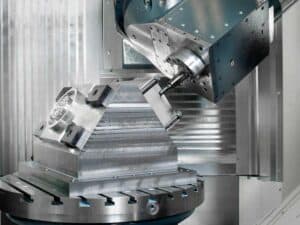
In CNC milling, a rotating multi-flute cutting tool removes material from a stationary (or repositioning) workpiece. Modern 5-axis milling centers can approach the workpiece from virtually any angle in a single setup — which means complex contoured surfaces, compound angles, and deep pockets that previously required multiple setups (and the tolerance stackup that comes with them) can now be completed in one go.
CNC milling handles anything with flat surfaces, slots, pockets, or irregular 3D geometry. It's the backbone process for brackets, housings, plates, manifolds, and structural components.
CNC Turning
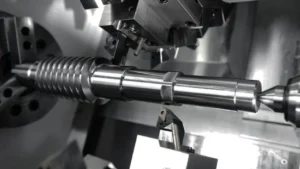
CNC turning rotates the workpiece while a cutting tool moves in a controlled linear path. It's the right process for cylindrical parts: shafts, bushings, pins, valve stems, threaded fasteners. Modern CNC lathes with live tooling can also drill, mill, and thread in the same operation, dramatically reducing the number of setups a complex rotational part requires.
Swiss-Type CNC Machining
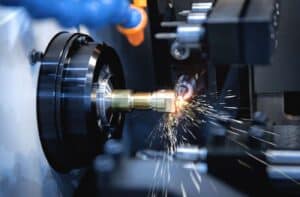
Swiss-type CNC machining was originally developed for watchmaking in Switzerland, a context that demanded extreme precision on parts measured in millimeters. Today it's one of the most capable processes in precision manufacturing for small, tight-tolerance components.
What makes Swiss machining different is how it supports the workpiece: the bar stock is guided very close to the cutting zone by a guide bushing, virtually eliminating deflection even on slender, small-diameter parts. The result is tolerances and surface finishes that standard CNC turning simply can't match on small parts. Medical components, instrument parts, miniaturized aerospace fittings - these are Swiss machining's home territory.
Precision Grinding
Grinding uses an abrasive wheel rather than a cutting tool to remove material. It's typically a finishing operation, the step after milling or turning that brings a part to its final, tightest dimension and surface finish. High precision grinding can achieve surface finishes measured in microinches (Ra 4–8 µin), a smoothness that other machining processes cannot reach.
When a part must mate perfectly with another component under load, or must have a bearing surface that resists wear over millions of cycles, grinding is what delivers that result.
EDM and Specialty Processes
Electrical Discharge Machining (EDM) erodes material using controlled electrical sparks rather than mechanical cutting. This makes it the process of choice for hardened materials, intricate internal geometries, and features too fine for conventional tooling. It does not exert cutting forces on the workpiece, so even fragile or thin-walled features can be machined without distortion.
Beyond these core processes, a full-service precision machine shop also handles drilling, tapping, reaming, honing, and coordinates post-machining operations such as heat treatment, surface coating, and plating through outside process management.
Precision Machining Capabilities: What a Modern Shop Can Actually Do
"Precision machining" on a supplier's website can mean a lot of things. Here is what genuine precision machining capabilities look like in a well-equipped, AS9100 Rev D-certified shop:
- Multi-axis CNC milling (3-axis through 5-axis) for complex 3D geometries
- CNC turning and Swiss-type turning for cylindrical and small-diameter parts
- Precision surface, cylindrical, and centerless grinding
- EDM for hardened materials and fine internal features
- Precision drilling, tapping, and threaded insert installation
- CMM (Coordinate Measuring Machine) inspection at the machine and in a dedicated inspection room
- SPC (Statistical Process Control) data collection for production runs
- Full material traceability from raw stock certification through finished part
The breadth of these capabilities is what allows a shop to serve aerospace, defense, and energy customers, industries where a part may need to be turned, milled, ground, inspected, and documented all within the same four walls to preserve the chain of custody that quality management systems require.
Materials Used in Precision Machining
Material selection in precision machining is as consequential as process selection. The material dictates which processes can be used, what tolerances are achievable, how long the tooling lasts, and ultimately whether the part will survive in service.
Aluminum is the workhorse. It machines quickly, holds excellent tolerances, produces clean surface finishes, and is relatively gentle on tooling. Alloys like 6061 and 7075 are standard in aerospace and automotive components where strength-to-weight ratio matters.
Stainless steel (303, 304, 316, 17-4PH) brings corrosion resistance and strength. It is tougher to machine than aluminum — it work-hardens, generating heat that wears tools — but it is indispensable for medical devices, food processing equipment, and marine components.
Titanium (particularly Ti-6Al-4V) is the material of choice when you need strength that matches or exceeds steel at roughly half the weight, plus biocompatibility. It is notoriously difficult to machine: it generates significant heat, has low thermal conductivity (meaning that heat stays concentrated at the cutting edge rather than dissipating into the chip), and work-hardens. A shop that machines titanium well is demonstrating real process capability.
Inconel and other nickel superalloys are the hardest-to-machine materials in common use. They retain their strength at extreme temperatures, which is why they appear in turbine blades and combustion chamber components, and which is also why cutting them is slow, tooling-intensive work.
Engineering plastics (PEEK, Ultem, Nylon, Delrin) round out the palette. When a component needs to be lightweight, chemically resistant, or electrically insulating, a precision-machined plastic part often outperforms a metal alternative.
After machining, material integrity doesn't just get assumed; it gets verified. Precision testing confirms that the machining process hasn't altered the material's properties, which matters particularly in aerospace and medical applications where material certification is a contractual requirement.
Precision Machining Tolerances: How Tight Is Tight Enough?
Tolerances are the language of precision machining, and misunderstanding them is one of the most expensive mistakes a design engineer can make.
A tolerance defines how much a dimension can deviate from its nominal value and still be acceptable. It looks like this on a drawing: 1.500" ± 0.001" — meaning the acceptable range is 1.499" to 1.501".
Here is a practical tier structure:
General machining: ±0.005" to ±0.010" — standard production work, no special handling required.
Precision machining: ±0.001" to ±0.002" — requires controlled setups, quality tooling, and in-process measurement.
High precision machining: ±0.0005" to ±0.0002" — demands temperature-controlled environments, premium equipment, and skilled operators.
Ultra-precision: tighter than ±0.0001" — the domain of semiconductor and optical manufacturing, requiring purpose-built equipment.
The important principle is this: specify the tolerance you actually need, not the tightest one theoretically possible. Every step tighter in tolerance multiplies cost, in setup time, inspection time, scrapped parts, and tooling wear. A well-designed part has functional tolerances where they matter and relaxed tolerances everywhere else.
Every finished part goes through precision inspection services to verify it meets the documented tolerance stack before it ships. CMM data, surface finish measurements, and dimensional reports travel with the part, not just the part itself.
Industries That Depend on Precision Machining
Aerospace Machining
Aerospace is where precision machining earns its reputation under the harshest conditions. Aerospace machining involves materials like Inconel 718, titanium 6Al-4V, and hardened steel alloys, materials that are difficult to machine precisely because they are designed to resist the very forces that cutting applies to them.
The tolerances required for flight-critical components are unforgiving. A turbine blade airfoil profile must be held within a few thousandths of an inch across dozens of measured cross-sections. A structural fastener hole location might be toleranced to ±0.001" to ensure proper load distribution in an assembly. Miss either spec and the part is scrap, or worse, a liability.
This is why aerospace machining is not just about having the right machines. It requires an AS9100 Rev D quality management system, the aerospace industry's certification standard, maintained by the International Aerospace Quality Group, governing everything from raw material traceability to first article inspection documentation. The certification doesn't mean you're good; it means your quality system is proven, audited, and accountable.
Oil & Gas and Energy
The oil and gas sector puts precision-machined components through conditions that would destroy lesser parts: extreme pressure, corrosive fluids, abrasive environments, and thermal cycling. Downhole tools, valve bodies, pump housings, wellhead components, and manifold assemblies all demand tight tolerances to seal reliably under pressure.
API Q1 certification, the American Petroleum Institute's quality management standard for oil and gas equipment manufacturers, defines the quality requirements for this sector. It governs the same disciplines as AS9100 but is specifically tailored to the demands of upstream and midstream energy applications.
Defense
Defense precision machining operates under ITAR (International Traffic in Arms Regulations) compliance requirements, which govern what can be manufactured, who can manufacture it, and where machined defense components can go. The technical requirements parallel aerospace: extreme tolerances, rigorous traceability, and no tolerance for "close enough", with the addition of strict export control obligations.
Medical Device Manufacturing
Precision machining for the medical sector adds a dimension that aerospace and defense don't share: the parts interact with the human body. Beyond tight tolerances, medical components must meet biocompatibility requirements (the material cannot react with human tissue), surface finish specifications (a rough implant surface harbors bacteria), and full regulatory traceability from raw material to finished device.
Orthopedic implants, surgical instruments, diagnostic housings, and catheter components are all produced through precision machining processes. The stakes - patient safety - make this arguably the most demanding application in the field.
Automotive and Industrial
Modern automotive manufacturing is more precision-intensive than ever, not less. The rise of electric vehicles has shifted the precision requirements from combustion engine components (pistons, valve bodies, crankshafts) to motor housings, battery thermal management manifolds, and high-voltage connector assemblies. The tolerances haven't relaxed; the part families have shifted.
Industrial machinery, semiconductor fabrication equipment, and test & measurement devices round out the major users of precision machining. Any application where repeatable performance under load matters is a precision machining application.
The Role of Inspection and Quality in Precision Machining
Precision machining without rigorous measurement is just machining with ambitions. The inspection process is not a final gate — it is woven through the entire production workflow.
In-process measurement happens at the machine: probing systems on modern CNC centers can measure a feature mid-cycle and automatically compensate the cutting program if it detects drift. This is particularly important in long production runs where tool wear shifts dimensions gradually.
Post-machining CMM inspection verifies every critical dimension against the engineering drawing, generating dimensional reports that document actual-versus-nominal measurements. Surface profilometers measure Ra and Rz values for surface finish. Hardness testers, spectrometers, and tensile test samples verify material properties when the application demands it.
At a certified precision machine shop, none of this is optional. Precision inspection services are the documented proof that the part meets spec, and that documentation travels with every shipment, providing the traceability that aerospace, medical, and defense customers contractually require.
Precision Machining vs. Manufacturing: What's the Difference?
Manufacturing is the umbrella. Precision machining is one of the disciplines within it.
Manufacturing covers everything: casting, forging, molding, welding, extrusion, stamping, and machining. Precision machining specifically means material removal — cutting, turning, grinding, drilling — performed to tight tolerances with documented verification.
In practice, a single part often moves through both worlds. A component might start as a forged blank (manufacturing), get rough-machined to near-net shape, then precision-machined to final dimensions, ground, inspected, anodized, and laser-marked, all within a single production workflow. The precision machining stage is not separate from manufacturing; it is usually the step that makes the other steps matter.
What makes industrial precision machining distinct is the emphasis on measurement. In precision work, the deliverable is not just the part; it is the part plus documented proof that it meets specification. That is the difference between a part and a certified part, and it is the difference that regulated industries pay for.
What Separates a Good Precision Machine Shop From a Great One
There are thousands of shops with CNC machines. The machines themselves are not the differentiator. Here is what actually separates commodity shops from precision machining leaders:
Certifications that are actually maintained. AS9100 Rev D, ISO 9001, API Q1, and ITAR registration are not plaques on the wall — they require continuous auditing, process discipline, and documented corrective actions when anything deviates. A shop with current certifications has a functioning quality management system, not just claims of quality.
Process engineering, not just job setup. Great precision machine shops don't just load a program and hit cycle start. They engineer the cutting process, selecting the right toolpath strategy, managing chip evacuation, controlling thermal growth, optimizing cutting parameters to maximize tool life without sacrificing accuracy.
Experience in the verticals you serve. A shop that has machined aerospace components for 40 years understands the DFAR material compliance requirements, the first article inspection documentation format, and the AS9100 audit trail an OEM will demand. That institutional knowledge cannot be purchased with new equipment.
Measurement capability that matches the work. A shop producing ±0.0002" tolerances needs a CMM that can measure to ±0.00005", and that CMM needs to be in a temperature-controlled room and calibrated on a traceable schedule. The measuring equipment must be more capable than the process it is measuring.
Founded in 1981, Shamrock Precision, a precision machining company in Dallas, TX, has spent over four decades building the process discipline, equipment base, and quality systems that demanding customers in aerospace, oil & gas, and defense require. The certifications — AS9100 Rev D, ISO 9001, API Q1, ITAR — reflect the quality system; the experience reflects what that system has produced over four decades.
The Future of Precision Machining
The precision machining industry is not standing still. Several shifts are reshaping what shops can do and what customers can expect.
In-process measurement is moving from an after-the-cut step to a mid-cut one. Probing systems integrated directly into machining centers allow the machine to measure critical features while the part is still fixtured, adjust the cutting program for any detected drift, and produce tighter real-world tolerances without slowing cycle time.
5-axis and multi-tasking machines continue to compress what used to take three setups into one. Fewer setups mean fewer tolerance stackup errors and faster throughput, both of which translate directly to better parts at lower cost.
Automation and lights-out machining — robotic part loading, automated tool changers, pallet systems - are allowing precision machine shops to run CNC machines through overnight shifts without adding headcount. This increases capacity and allows companies to take on larger programs without proportional increases in operating cost.
Digital twins and simulation allow shops to model a machining process in software before touching material, identifying chatter, vibration, and deflection risks before they scrap an expensive workpiece. On tight-tolerance aerospace jobs with difficult materials, this is no longer a luxury.
Sustainability is also entering the precision machining picture, through high-pressure coolant systems that reduce cutting heat and tool wear, through coolant recycling, and through optimized toolpaths that remove more material per pass and reduce overall cycle time and energy consumption.
Frequently Asked Questions About Precision Machining
Q: What is precision machining, in simple terms?
Precision machining is the process of cutting or shaping a material to very exact dimensions using CNC machines, where the margin of error is far tighter than standard machining. Think of it as the difference between a rough cut and a surgical cut; the intent and the equipment are fundamentally different.
Q: What is the difference between CNC machining and precision machining?
CNC machining describes the control method; a computer program drives the machine. Precision machining describes the accuracy target — tolerances far tighter than general production work. Most precision machining today uses CNC control, so the terms frequently overlap. But CNC machining is not automatically precision machining; a roughing operation on a CNC machine is still CNC machining, just not precision work.
Q: What industries use precision machining the most?
Aerospace, defense, medical devices, oil and gas, and semiconductor/electronics manufacturing are the heaviest users. These industries share one thing: components where dimensional accuracy directly affects safety, performance, or regulatory compliance.
Q: How accurate is precision machining?
General precision machining routinely holds ±0.001". High-precision work reaches ±0.0002". Ultra-precision processes operate in the nanometer range. The right level depends entirely on the functional requirement; tighter tolerances cost more and take longer, so good engineering specifies what the part actually needs.
Q: What is a precision-machined part?
Any component produced through precision machining processes to meet tight dimensional, geometric, or surface finish specifications. Turbine blades, orthopedic implants, fuel injector bodies, valve stems, optical mounts — if it has to be exactly right to work, it's a precision-machined part.
Q: Do I need special certifications to get precision-machined parts for aerospace or defense?
Your supplier does. For aerospace components, the shop should hold AS9100 Rev D certification. For defense work, ITAR registration is required. For oil and gas applications, API Q1 certification governs quality management. These are not optional in regulated industries; they are baseline requirements. Shamrock Precision holds all three, plus ISO 9001 and API Q1.
Q: What tolerances can precision machining hold?
Precision machining tolerance capability depends on the process and equipment. General machining holds ±0.005 inches. Standard precision machining achieves ±0.001 inches routinely. High precision machining pushes to ±0.0002 inches. Ultra-precision work for optics and semiconductor equipment operates tighter than ±0.0001 inches. Every finished part is verified by CMM inspection with documented measurement data to confirm it meets the required tolerance stack.
Q: What materials are used in precision machining?
The most common precision machining materials include aluminum alloys (6061, 7075), stainless steel (303, 304, 316, 17-4PH), titanium (Ti-6Al-4V), Inconel and other nickel superalloys, hardened steel, brass, copper, and engineering plastics such as PEEK, Ultem, and Delrin. Material selection depends on the application requirements — strength, weight, corrosion resistance, biocompatibility, and machinability all factor into the choice.
Conclusion
Precision machining is the process that makes reliable, high-performance manufacturing possible. Without it, the components that power aircraft engines, support surgical procedures, and keep energy infrastructure running would not exist in the forms they need to.
What sets a capable precision machining operation apart isn't the machines alone; it's the combination of process expertise, quality systems, measurement capability, and deep experience in the industries being served. That combination is what turns a CNC program into a part that ships on time, passes inspection, and performs in the field.
If you have a part with tight tolerances, difficult materials, or demanding industry requirements, contact us to discuss what Shamrock Precision can do for your program. We've been getting it right since 1981.