
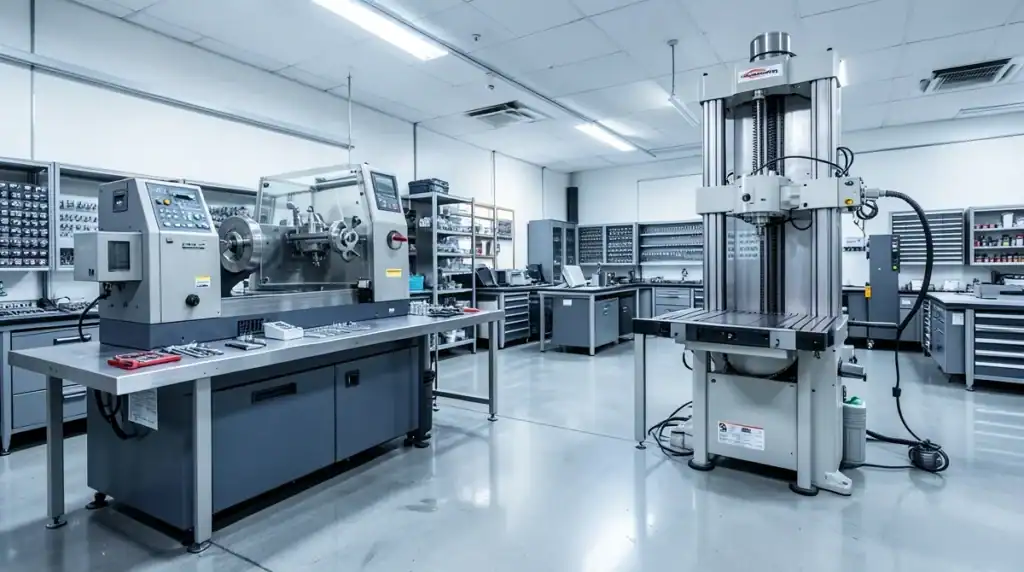
In CNC turning the workpiece rotates against a fixed cutting tool. In CNC milling the tool rotates against a fixed workpiece. That single reversal decides which process suits a part: turning produces cylindrical geometry such as shafts, pins, bolts, and fasteners, while milling produces prismatic geometry.
Shamrock Precision is an ISO 9001 and AS9100 certified CNC machine shop in Dallas, Texas, machining precision components for aerospace, energy, defense, telecommunications, and industrial manufacturers since 1981. The shop runs both processes under one quality system, which means the choice between them gets made on the part rather than on what happens to be available. This article sets out how each process builds geometry, where the boundary between them sits, and what happens to parts that need both.
What is the difference between CNC turning and CNC milling?
The difference is which element rotates. CNC turning spins the workpiece against a stationary cutting tool, which is the opposite arrangement to milling, where the cutter rotates. Turning suits cylindrical parts machined to precise, repeatable dimensions. Milling suits parts built from flat faces, pockets, and features on several sides.
Everything else follows from that. A lathe generates a surface of revolution because the part is revolving, which is why diameters, tapers, faces, grooves, and threads come naturally to it and a rectangular pocket does not. A mill has no such constraint, and no particular advantage on a long concentric diameter.
Which parts belong on a lathe?
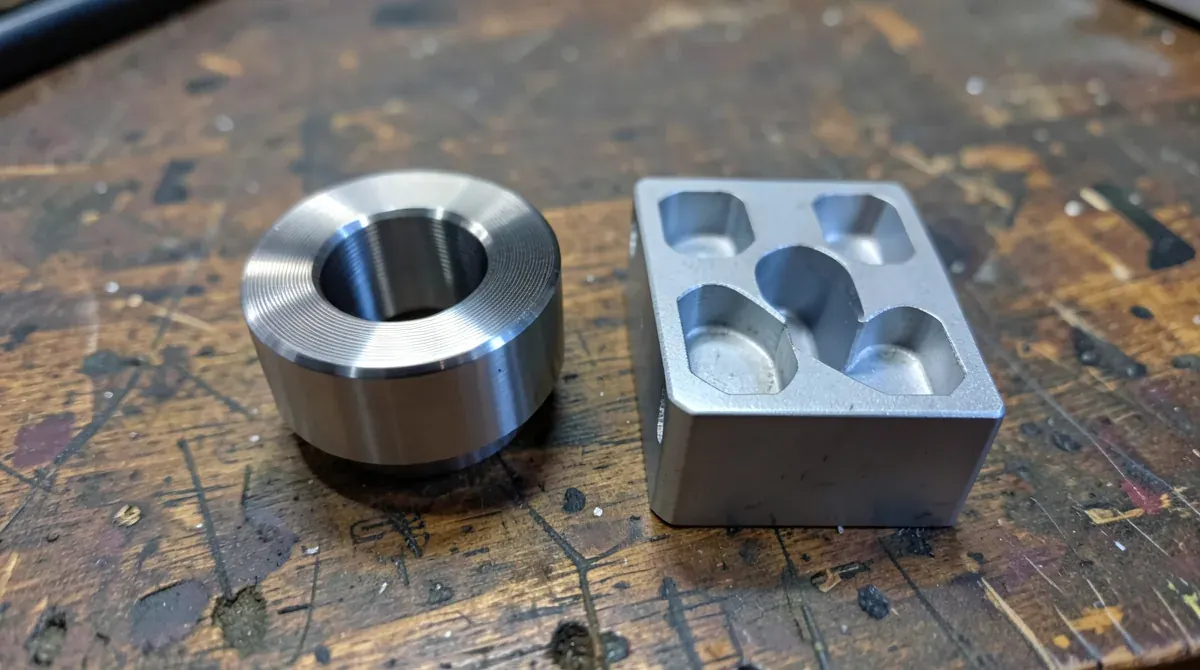
Parts whose defining geometry is round belong on a lathe. Shamrock Precision lists shafts, pins, bolts, and fasteners as typical turned work, alongside shear screws and precision fasteners, knurled and grooved pins, parts for harsh environments, large-scale machined components, and complex multi-feature parts.
The practical test is what the part would look like if you spun it. If the profile sweeps cleanly around a centerline, the geometry is being generated by the rotation itself rather than built up from a series of tool passes.
Size matters to that decision as well. Shamrock Precision’s turning center works on parts up to 16 inches in diameter, with maximum turning length reaching 59 inches. The turning department runs 4140, 303, 304, and 316 steels and stainless, Inconel and Monel grades, 2011, 2024, and 6061 aluminum, brass, manganese bronze, and titanium 6AL-4V, so material is rarely what decides the process.
What happens to parts that need both?
Many parts do. A turned body with a cross hole, a flat, or a milled slot needs both kinds of cutting. The choice is whether the part moves to a second machine or whether a multi-axis turning center with live tooling cuts the off-axis features in the same setup as the diameters.
That second route is the one worth understanding, because it changes both the quoted cost and the relationship between features. Shamrock Precision runs multi-axis CNC turning with 4-axis and 7-axis capability, and the 7-axis machines complete parts that would need multiple setups or multiple machines without it. The detail is in what extra axes actually change on a turned part.
Who decides, and on what basis?
The print decides, read against the shop’s capability. Diameter, length, feature positions, and the tolerances attached to each one determine which process can produce the part and in how many operations. Shamrock Precision states that it directs a part toward the right process based on its size, features, and tolerances.
Both processes are operated by the same trade, and that trade is not growing. The U.S. Bureau of Labor Statistics counted about 288,300 machinist jobs in 2025 and projects roughly 1 percent growth through 2035 in its 2025 to 2035 projections. Machinists and tool and die makers together are projected to decline about 1 percent over the same period. BLS projects about 30,400 openings a year across the two occupations and attributes all of them to replacing workers who move to other occupations or leave the labor force rather than to growth. The median annual wage for machinists was $58,750 in May 2025.
That matters to process selection because both turning and milling depend on people who can read a print, plan an operation sequence, and judge when something has shifted. How that shows up on a quotation is covered in what drives the cost of a turned part.
Frequently Asked Questions About CNC Turning and CNC Milling
01Which process should I ask for?
In most cases you do not have to choose. Shamrock Precision states that it directs a part toward the right process based on its size, features, and tolerances, and the shop runs turning and milling under one quality system, so the print, the material, and the quantity are enough to start.
02Can a lathe drill an off-center hole?
A conventional two-axis lathe cannot, because every feature it cuts is a surface of revolution. A turning center with live tooling and a positioned spindle can, which is the capability that lets off-axis features be cut without moving the part to a milling machine.
03Which process holds tighter tolerances?
Neither by default. Tolerance capability depends on the machine, the fixturing, the material, the feature, and the measurement behind the number. Shamrock Precision publishes turning tolerances of plus or minus 0.001 inches on standard components and tighter on critical features, depending on geometry and material.
04What is a turning center?
A turning center is a CNC lathe with capability beyond two-axis work, typically including live tooling, a sub-spindle, or additional axes. Shamrock Precision’s turning center handles parts up to 16 inches in diameter with maximum turning length reaching 59 inches.
05Do I need to choose before requesting a quote?
No. Shamrock Precision states that it directs a part toward the right process based on its size, features, and tolerances. Sending the print, the material, and the quantity is enough to start that conversation.
Shamrock Precision: Turning and Milling Under One Quality System
Shamrock Precision has machined precision components since 1981 from Dallas, Texas. The shop is ISO 9001 and AS9100 certified, with Swiss machining, milling, turning, and inspection under one quality system.
Our Services Include:
- CNC Turning: Cylindrical components, shafts, pins, bolts, and fasteners, prototypes through production
- CNC Milling: Prismatic geometry and features across multiple faces
Qualifying a new supplier? Request a quote with your print, material, and quantity.
Works Cited
- United States, Bureau of Labor Statistics. “Machinists and Tool and Die Makers.” Occupational Outlook Handbook, U.S. Department of Labor, 27 Aug. 2026, www.bls.gov/ooh/production/machinists-and-tool-and-die-makers.htm.