
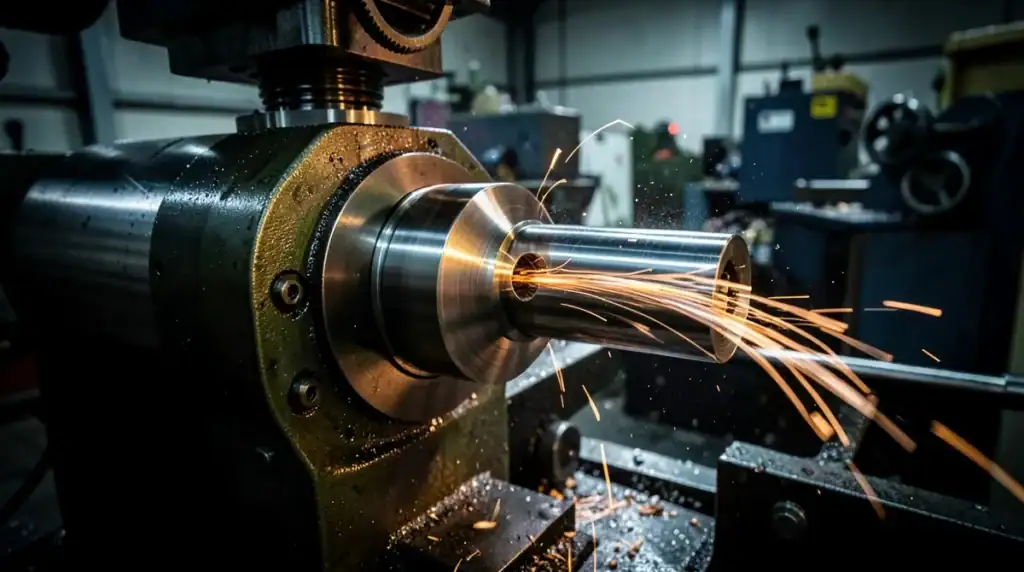
A turned part is quoted per job rather than priced from a list. Five things on the drawing shape the number: how many setups the geometry requires, the tolerance on the tightest feature, the material specified, the quantity ordered, and the inspection documentation the program calls for. Shamrock Precision quotes from the print.
Shamrock Precision is an ISO 9001 and AS9100 certified CNC machine shop in Dallas, Texas, machining precision components for aerospace, energy, defense, telecommunications, and industrial manufacturers since 1981. Machining is quote-driven work, and no shop can price a part without the print. What follows is not a price list. It is an account of which decisions on a drawing move a turned part’s cost, so the tradeoffs are visible before the drawing is finished.
How much does CNC turning cost?
There is no list price for turned parts. Cost is calculated per job from material, setup count, cycle time, tooling, quantity, and inspection requirements. Two parts with identical outside dimensions can be quoted very differently if one carries a tighter tolerance or a first article requirement and the other does not.
A print, a material specification, and a quantity are the minimum needed for a meaningful number.
Why do setups cost more than cycle time?
A setup is work performed once per operation, whatever the quantity: work holding, locating the part, setting tool offsets, and proving the program. A second operation on a second machine adds another setup, along with handling between machines and a second locating of the part.
Setup count is settled by geometry. A part whose features all sit on one axis runs in one setup. A part with a cross hole either takes a second operation or requires a turning center with live tooling that can cut it alongside the diameters. Shamrock Precision’s 7-axis machines complete parts that would need multiple setups or multiple machines without it, and the mechanics of that are covered in what extra axes actually change on a turned part.
How much does a tighter tolerance add?
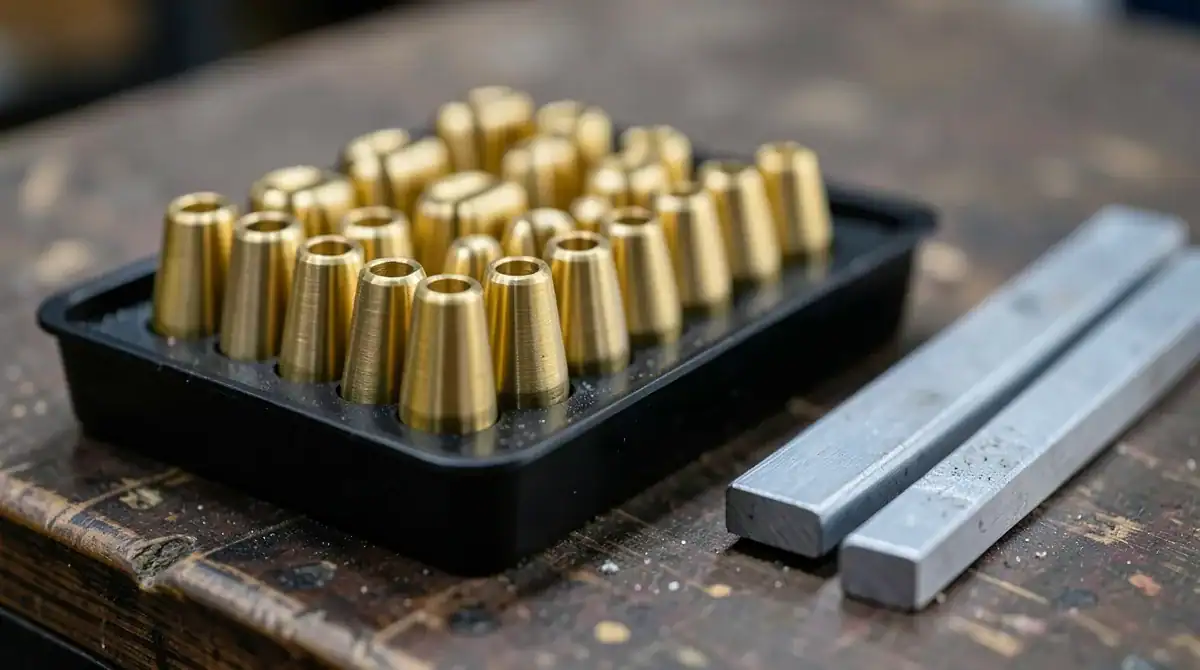
A tighter tolerance narrows the acceptable band on a feature, which changes how the job is cut, how often it is measured, and how much of the run can be accepted. Shamrock Precision publishes turning tolerances of plus or minus 0.001 inches on standard components, plus or minus 0.0005 inches on critical features, and as tight as plus or minus 0.0001 inches on specific features depending on geometry and material.
The important word there is “specific.” Shamrock Precision’s published figure for the tightest capability is qualified by part geometry and material, which means it describes what is achievable on a given feature rather than a blanket number applied across a whole drawing.
What does the material change?
Material is specified on the print, and the grade called for determines the raw stock cost and which machines and tooling the job needs. Shamrock Precision’s turning department publishes the grades it runs, spanning carbon and stainless steels, nickel alloys, aluminum, brass, bronze, and titanium.
Shamrock Precision’s turning department runs 4140, 303, 304, and 316 steels and stainless; Inconel 625, 718, 725, and 925, A286, and Monel K500 and 400; 2011, 2024, and 6061 aluminum; and brass 360 and 464, manganese bronze, and titanium 6AL-4V. Which grade a print calls for is an engineering decision made by the designer, not by the shop quoting the part.
What does inspection add?
Inspection scales with the number of characteristics on the print and the documentation the program requires. Shamrock Precision provides inspection documentation including First Article Inspection Reports for high-reliability components, in which every characteristic on the drawing is measured and recorded rather than a sample of them.
Documentation is also where a measurement claim has to mean something specific. The National Institute of Standards and Technology defines metrological traceability as a property of a measurement result that can be related to a reference through a documented, unbroken chain of calibrations, each contributing to the measurement uncertainty. NIST states that traceability belongs to measurement results rather than to organizations or laboratories, that having an instrument calibrated is not by itself sufficient, and that traceability alone does not establish fitness for a particular purpose, because that depends on whether the uncertainty is small enough for the application.
Shamrock Precision provides inspection documentation including First Article Inspection Reports for high-reliability components, and works under an ISO 9001 and AS9100 quality system with material traceability on every job through its CNC turning department.
Frequently Asked Questions About Turned Part Cost
01Does quantity reduce the price per part?
A run carries one setup whatever its size, so a hundred parts share that work across more pieces than ten do. Shamrock Precision scales from single prototype parts through production runs under the same quality system.
02Is it cheaper to loosen tolerances?
Where the application allows it, yes. A looser band widens what the process has to hit and what the run can accept. The decision belongs to the engineer who owns the design, not to the shop quoting it.
03What inspection documentation is available?
Shamrock Precision provides inspection documentation including First Article Inspection Reports for high-reliability components. The shop is ISO 9001 and AS9100 certified and carries material traceability on every job, and the documentation a program requires is priced as part of that job.
04Does a prototype cost more per part?
A single part carries the whole setup rather than sharing it across a run. That is a function of quantity rather than of the part being a prototype. Shamrock Precision quotes prototypes and production runs under the same process.
05What do you need to quote a turned part?
The print, the material specification, and the quantity. Tolerance callouts, finish requirements, and any inspection documentation the program requires all affect the number, so including them at the outset produces a more accurate quotation.
Shamrock Precision: CNC Turning and Inspection in Dallas
Shamrock Precision has machined precision components since 1981 from Dallas, Texas. The shop is ISO 9001 and AS9100 certified, with Swiss machining, milling, turning, and inspection under one quality system.
Our Services Include:
- CNC Turning: Multi-axis lathe work, prototypes through production runs, with material traceability
- Precision Testing: Dimensional, material, and functional verification against specification
Qualifying a new supplier? Request a quote with your print, material, and quantity.
Works Cited
- United States, National Institute of Standards and Technology. “Metrological Traceability: Frequently Asked Questions and NIST Policy.” U.S. Department of Commerce, 27 May 2026, www.nist.gov/metrology/metrological-traceability.