
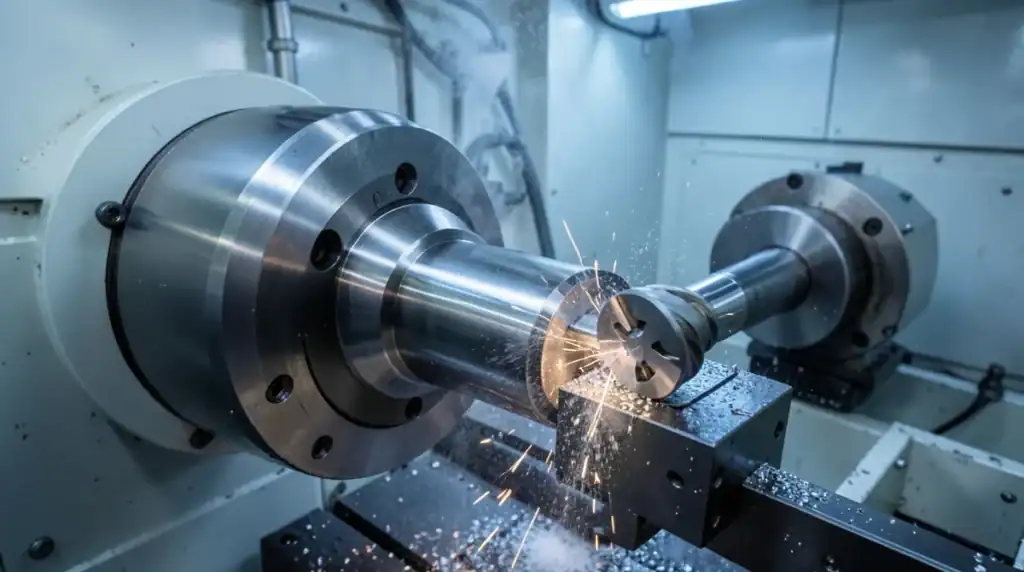
Multi-axis CNC turning adds milling capability and additional axes of movement to a turning center, so complex features, off-center holes, and contoured surfaces can be machined in a single setup. Shamrock Precision runs 4-axis and 7-axis turning in Dallas, Texas, where a 7-axis machine completes parts that would need several setups or several machines without it.
Shamrock Precision is an ISO 9001 and AS9100 certified CNC machine shop in Dallas, Texas, machining precision components for aerospace, energy, defense, telecommunications, and industrial manufacturers since 1981. The turning department runs both 4-axis and 7-axis equipment, and the gap between those two numbers decides more about a part than most prints suggest. This article explains what each added axis does, when the capability earns its cost, and how setup count connects to the tolerances on the drawing.
What is multi-axis turning?
Multi-axis turning is lathe work with milling capability and extra axes of movement built into the turning center. Beyond rotating the workpiece against a cutting tool, the machine can drive rotating tools, index the spindle to a position, and cut features that do not sit on the part’s centerline, all without releasing the part.
A two-axis lathe moves a tool along two directions, along the part and across it. Every feature it produces is a surface of revolution: diameters, tapers, faces, grooves, threads. Anything else has to go somewhere else.
Adding axes removes that limit. A positioned spindle holds the part at a chosen angle rather than spinning it freely, and live tooling drives a rotating cutter against the stationary part. A cross hole, a flat, a keyway, or a milled slot becomes a turning operation rather than a second job on a second machine.
What does a sub-spindle do?
A sub-spindle is a second work-holding spindle facing the main spindle. It takes the part directly from the main spindle after the front features are cut, then presents the back end for machining. The part is finished complete in one machine, with no manual reload between the two ends.
At Shamrock Precision, the CNC turning department runs an Okuma Multus U3000 with a 10-inch three-jaw main chuck and an 8-inch three-jaw sub-spindle carrying a 3-inch through bore, and an Okuma LB3000 pairing an 8-inch main chuck with a 6.5-inch sub-spindle chuck. Mazak turning centers include a QT Nexus 100M, which carries milling capability, alongside a QT 100S and a QT Nexus 250-II.
Why does setup count matter more than machine count?
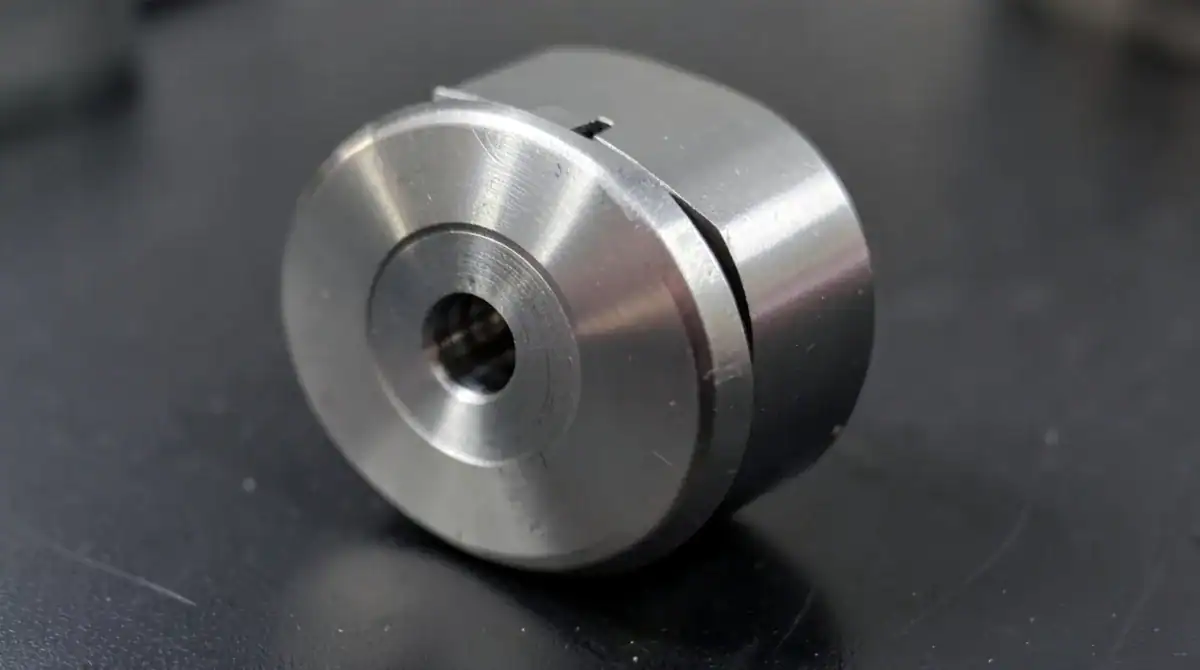
Each time a part is unclamped and re-fixtured, it has to be located again, and the new location carries its own error. Features cut in separate setups accumulate that error between them. Cutting more features in one setup keeps them referenced to a single location, which protects relationships the print calls out between them.
Geometric dimensioning and tolerancing is the language prints use to state those relationships, and ASME publishes ASME Y14.5 as the authoritative guideline for it. The 2018 edition, reaffirmed in 2024, establishes the symbols, rules, definitions, and recommended practices for stating and interpreting GD&T on engineering drawings and on models defined in digital data files. It replaced the 2009 edition.
When a print ties a cross hole back to a turned diameter through a datum reference, the two features are being asked to agree. Producing them in the same setup is the most direct way to make that agreement hold.
When is multi-axis turning worth it?
Multi-axis turning pays when a part carries features on more than one axis, when the print ties those features together through datums, or when the volume is high enough that removing a second operation matters. A simple turned bushing with no off-axis features gains nothing from seven axes.
Added axes are not a general upgrade. They address three situations: features off the centerline, back-end work without a reload, and parts where the number of re-locations matters. A part that meets none of those runs on a two-axis machine.
What size parts can multi-axis turning handle?
Shamrock Precision publishes its turning envelope. The turning center works on parts up to 16 inches in diameter. The 4-axis milling and turning combination handles up to 8 inches in diameter on the main spindle with a 6-inch sub-spindle, and the 7-axis lathes take work up to 16 inches in diameter. Maximum turning length reaches 59 inches, or 1500 millimeters.
For small-diameter work below that range, the process question changes, and the trade-offs are set out in how CNC turning and CNC milling differ. Where setup count lands on a quotation is covered in what drives the cost of a turned part.
Frequently Asked Questions About Multi-Axis CNC Turning
01How many axes does a CNC lathe have?
A conventional CNC lathe works in two axes. Adding live tooling and a positioned spindle brings it to four. Shamrock Precision runs 4-axis machines and 7-axis machines, with the 7-axis configuration completing parts that would need several setups or several separate machines to finish without it.
02What is live tooling on a lathe?
Live tooling is a driven, rotating cutter mounted in a lathe’s turret. Because the cutter spins while the workpiece is held at a position rather than rotating, the machine can drill, mill, and tap features off the part centerline without moving the part to a milling machine.
03Does multi-axis turning improve accuracy?
It reduces the number of times a part is located, which removes a source of error between features cut in different setups. Accuracy on any single feature still depends on the machine, the tooling, the material, and the measurement behind the number on the print.
04Can multi-axis turning replace milling entirely?
No. Turning builds geometry by rotation, so parts that are fundamentally prismatic rather than cylindrical still belong on a mill. Multi-axis turning handles off-axis features on parts that are turned work in every other respect, which is a narrower and different job.
05Is multi-axis turning suitable for prototypes?
Yes. Shamrock Precision scales from single prototype parts through production runs, and provides inspection documentation including First Article Inspection Reports for high-reliability components, under an ISO 9001 and AS9100 quality system with material traceability on every job.
Shamrock Precision: CNC Turning in Dallas Since 1981
Shamrock Precision has machined precision components since 1981 from Dallas, Texas. The shop is ISO 9001 and AS9100 certified, with Swiss machining, milling, turning, and inspection under one quality system.
Our Services Include:
- CNC Turning: Multi-axis lathe work on parts up to 16 inches in diameter, prototypes through production runs
- Precision Inspection Services: Inspection and documentation for turned components
Qualifying a new supplier? Request a quote with your print, material, and quantity.
Works Cited
- American Society of Mechanical Engineers. “Y14.5: Dimensioning and Tolerancing, 2018 (R2024).” ASME, www.asme.org/codes-standards/find-codes-standards/y14-5-dimensioning-tolerancing/2018.