
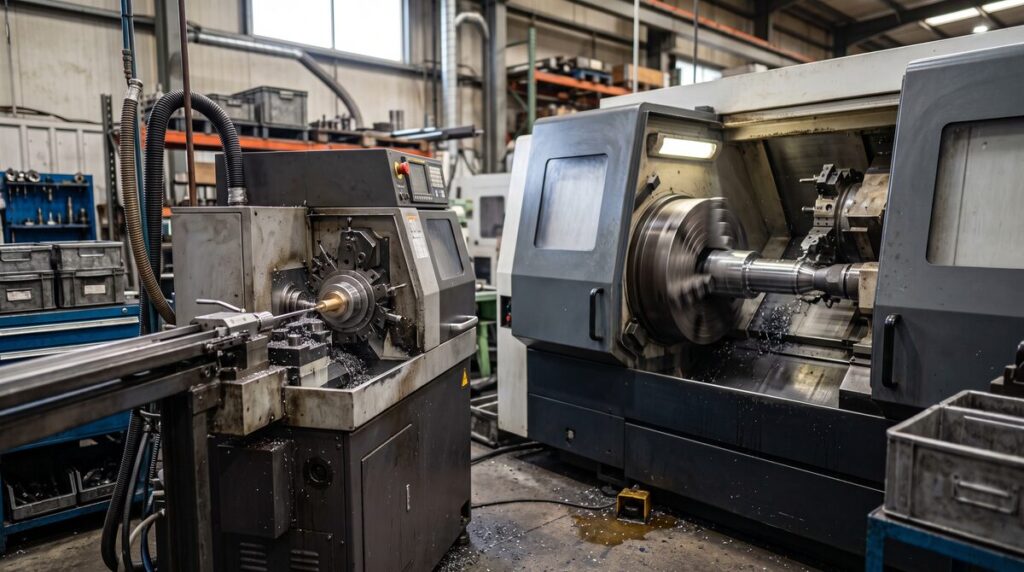
Oil field prints frequently specify small-diameter turned components. Two turning processes are commonly used to produce them, and the published descriptions of each differ on one point: where the material is supported during the cut.
How the two processes are described
Shamrock Precision publishes that Swiss machining supports the bar stock with a guide bushing directly next to the cutting tool, controlling the material at the point of cut. The company states that this reduces vibration and deflection, and that the result is improved straightness, tighter tolerances, and finer finishes, particularly on long, slender, small-diameter parts.
For conventional CNC turning, Shamrock publishes that the workpiece rotates against a fixed cutting tool, which the company describes as the opposite arrangement to milling, and as suited to cylindrical parts such as shafts, pins, bolts, and fasteners.
Where each process is applied
Shamrock Precision publishes a size-based distinction between the two. Standard CNC turning is described as suited to medium and larger parts. Swiss machining is described as specializing in small, precise parts, typically under 1.25 inches in diameter, where accuracy and surface finish are the governing requirements. The company states that it directs a part toward one process or the other based on its size, features, and tolerances.
On capacity, the company publishes that its turning centers work on parts up to 16 inches in diameter, and that multi-axis turning adds milling capability and additional axes of movement, allowing complex features, off-center holes, and contoured surfaces to be machined in a single setup.
Components Shamrock lists across its Swiss machining and turning pages include shear screws, valve stems, pressure fittings, knurled and grooved pins, and precision fasteners. Shear screws and pins are machined to customer print and specification.
The market conditions behind current demand for these components are set out in what the 2026 data shows about oil and gas component sourcing.
What NIST states a traceability claim requires
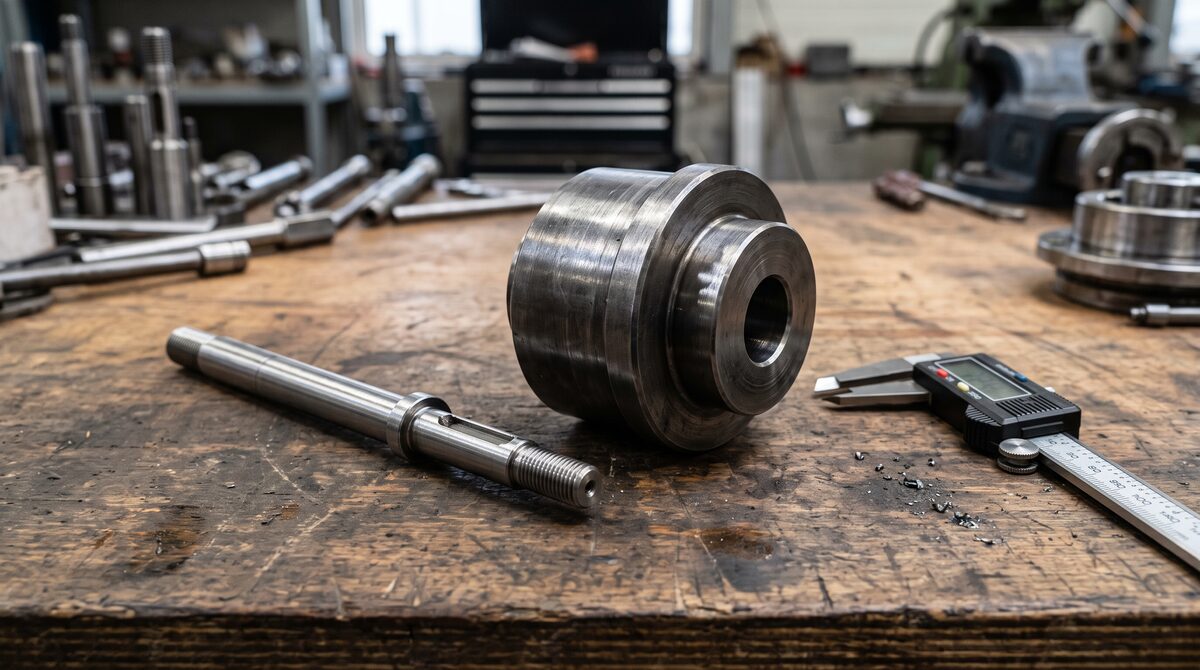
A tolerance figure on a quotation is a measurement claim. The National Institute of Standards and Technology publishes a specific definition of the term used to support such claims.
NIST defines metrological traceability as a property of a measurement result whereby the result can be related to a reference through a documented unbroken chain of calibrations, each contributing to the measurement uncertainty.
NIST makes three further statements about how the term applies:
- Traceability belongs to results, not to institutions. NIST states that only measurement results can be traceable, and that neither organizations nor laboratories can themselves be traceable.
- A calibrated instrument is not sufficient. NIST states that merely having an instrument calibrated, including by NIST, does not make a measurement result obtained with it traceable.
- Traceability does not establish fitness for purpose. NIST states that traceability imposes no restriction on the size of the uncertainty, and that fitness for a given application depends on whether that uncertainty is small enough.
NIST lists what a claim of traceability requires: a clearly defined property that was measured, a complete description of the measurement system or working standard used, a stated result comprising a measured value and a documented uncertainty evaluation, a complete specification of the reference, and internal measurement assurance programs covering both the measurement system and the reference.
What BLS reports about the workforce behind both processes
The U.S. Bureau of Labor Statistics published its 2025 to 2035 projections for machinists and tool and die makers in the Occupational Outlook Handbook.
- Machinists held about 288,300 jobs in 2025, with 291,200 projected for 2035, a change of about 1 percent.
- Machinists and tool and die makers together are projected to move from 344,900 to 342,700, a decline of about 1 percent.
- About 30,400 openings a year are projected across the two occupations over the decade. BLS attributes all of them to the need to replace workers who transfer to other occupations or leave the labor force, rather than to growth.
- The median annual wage for machinists was $58,750 in May 2025. BLS lists the median for all occupations at $50,980.
BLS also states that machinists’ work demands accuracy sometimes to within one ten-thousandth of an inch, and that machinists must be able to work with CAD and CAM technology, CNC machine tools, and manual and computerized measuring machines.
Supplier qualification and the documentation that accompanies either process are covered in what oil and gas buyers examine when qualifying a machine shop.
This article is general industry information and is not a substitute for the applicable standard, manufacturer documentation, or a qualified engineer’s assessment of your specific application.
Shamrock Precision: Swiss and Conventional Turning Under One Quality System
Shamrock Precision has machined precision components since 1981 from Dallas, Texas. The shop is ISO 9001 and AS9100 certified, with Swiss machining, milling, turning, and inspection under one quality system.
Our Services Include:
- Swiss Machining: Small-diameter, high-volume work where stability and repeatability decide the part
- CNC Turning: Turned components across a range of diameters, prototype quantities through repeat production
Qualifying a new supplier? Request a quote with your print, material, and quantity.
Works Cited
- United States, Bureau of Labor Statistics. “Machinists and Tool and Die Makers.” Occupational Outlook Handbook, U.S. Department of Labor, 27 Aug. 2026, www.bls.gov/ooh/production/machinists-and-tool-and-die-makers.htm.
- United States, National Institute of Standards and Technology. “Metrological Traceability: Frequently Asked Questions and NIST Policy.” U.S. Department of Commerce, 27 May 2026, www.nist.gov/metrology/metrological-traceability.