
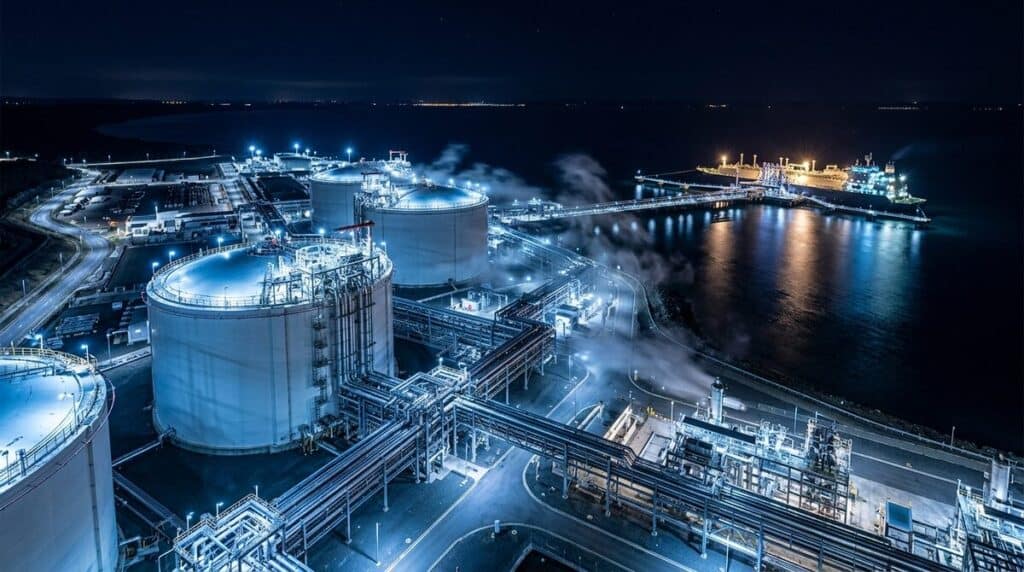
The single most consequential fact in the global gas market right now is a repair timeline.
An attack on Qatar’s Ras Laffan export facility on March 18 damaged two liquefaction trains and knocked out 17 percent of the country’s LNG export capacity. QatarEnergy estimates the repairs could take up to five years. Combined with the broader Strait of Hormuz disruption, the volumes sidelined exceed 10 billion cubic feet per day, roughly 20 percent of global LNG supply.
Supply that large does not get replaced. It gets partially backfilled, and the United States is doing most of the backfilling.
The U.S. Energy Information Administration forecasts U.S. LNG exports rising 1.9 Bcf/d in 2026 to average 17.0 Bcf/d, then climbing another 9 percent in 2027. Net U.S. natural gas exports grow 18 percent to 18.7 Bcf/d in 2026 and another 10 percent to 20.5 Bcf/d the following year. Current U.S. peak export capacity sits at 18.3 Bcf/d, which is why the buildout schedule matters more than the forecast.
Corpus Christi Stage 3 brings trains five through seven online this year, adding a combined 0.6 Bcf/d. Golden Pass starts its first two trains, adding 1.4 Bcf/d. Next year brings Port Arthur Phase 1 at 1.6 Bcf/d, Rio Grande trains one and two at 1.4 Bcf/d, and Golden Pass’s final train at 0.7 Bcf/d.
The physical footprint behind those numbers is larger than the export headlines suggest. The Federal Energy Regulatory Commission, which authorizes the siting and construction of onshore and near-shore LNG facilities under Section 3 of the Natural Gas Act, counts more than 170 LNG facilities operating in the United States and directly regulates twenty-seven of them. Export terminals are the visible tier of a considerably deeper industrial base.
The destination map is shifting alongside the volumes. In 2025, U.S. LNG exports to Europe reached a record 10.3 Bcf/d, up from 6.3 Bcf/d the year before and accounting for 68 percent of total export volumes. Exports to Asia fell to 2.5 Bcf/d. With Qatari cargoes bound largely for Asian buyers now constrained, the pull on American supply is coming from both directions at once.
Every one of those cubic feet has to be produced, gathered, and moved before it is chilled and loaded.
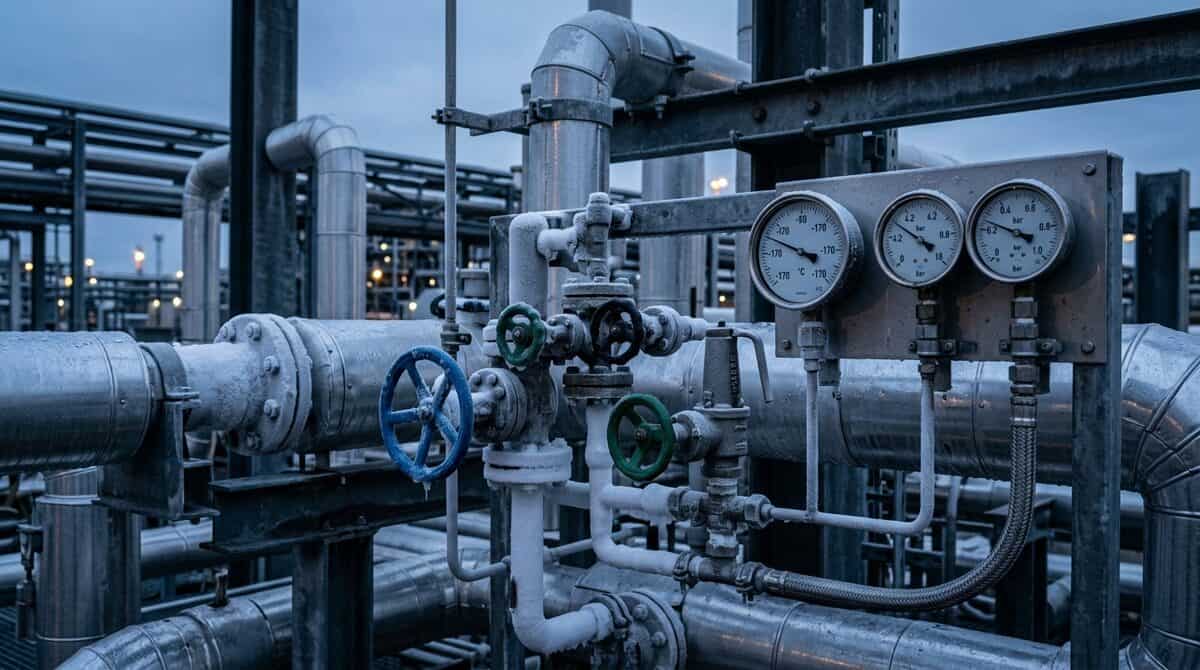
That is where the story stops being about terminals and starts being about wellheads. Sustained export pull at these volumes changes the economics of gas-directed drilling in the Permian, the Haynesville, and the Eagle Ford, and it does so at a moment when equipment and component delivery times are already stretching, a constraint documented in Oilfield Equipment Lead Times Are Stretching as Tariff Rules Rewrite the Sourcing Math.
Washington has been clearing the runway. In March, the Department of Energy authorized an immediate 13 percent export increase at Venture Global’s Plaquemines terminal in Louisiana, adding up to 0.45 Bcf/d and bringing that facility’s total authorization to 3.85 Bcf/d. Elba Island received a further 0.1 Bcf/d increase in April. DOE has now approved more than 18.6 Bcf/d of LNG export authorizations in total, a figure well in excess of the country’s physical export capacity, which means permitting is no longer the binding constraint.
The binding constraint is upstream. Operators surveyed by the Dallas Fed identified natural gas takeaway capacity as one of the two most significant limits on Permian drilling over the next twelve months, with most expecting the problem to resolve sometime in 2027 and the largest single group naming the first quarter of that year. Until pipe catches up, associated gas from oil-directed wells and dedicated gas programs compete for the same capacity.
For service companies and their suppliers, the practical read is that gas work is becoming less cyclical and more scheduled. Export contracts are long-dated. Liquefaction trains do not idle gracefully; a train running below design throughput burns efficiency and margin, so operators have every incentive to keep feedgas contracted and flowing regardless of where the spot price sits in a given month. That pressure transmits back up the chain as a steadier completion cadence than the crude side has managed under war-driven price swings, a divergence explored in The Federal Oil Price Forecast Assumed Peace. The War Resumed Three Weeks Later.
Steadier cadence carries its own supply chain implications, and they are not all comfortable. Predictable completion schedules mean predictable component consumption, and predictable consumption exposes any supplier whose lead times cannot be relied on. A crude program can absorb a slipped delivery by shuffling the sequence. A completion crew working a fixed calendar against contracted volumes has less room to improvise.
Precision components consumed downhole are the parts most likely to gate that calendar. Shear screws, setting tool hardware, and similar small machined parts are specified tightly, consumed in volume, and rarely substitutable on short notice. There is usually no equivalent sitting in the yard, and the part that stops a completion costs a fraction of the spread it idles.
The Qatari trains will come back eventually. The American infrastructure built to cover for them, and the drilling programs feeding it, will not be dismantled when they do.
Shamrock Precision: Domestic Precision Components for Oil & Gas
Since 1981, Shamrock Precision has machined precision components for drilling operations across the Permian Basin, Eagle Ford, Bakken, and offshore Gulf programs from its facility in Dallas, Texas.
Our Services Include:
- Shear Screws for Oil & Gas — Swiss CNC-machined shear screws from 0.125 to 0.875 inch, thread tolerances to 0.0005 inches, available in Inconel, stainless steel, brass, and aluminum. ISO 9001 and AS9100 certified.
- Precision CNC Machining — Complete precision machining services with full batch documentation and material traceability.
Running a Fixed Completion Calendar? Contact Shamrock Precision to discuss your requirements.
Works Cited
- “Energy Department Approves Immediate Additional LNG Exports from Plaquemines LNG.” U.S. Department of Energy, 13 Mar. 2026, www.energy.gov/articles/energy-department-approves-immediate-additional-lng-exports-plaquemines-lng. Accessed 30 July 2026.
- “LNG.” Federal Energy Regulatory Commission, 30 June 2026, www.ferc.gov/natural-gas/lng. Accessed 30 July 2026.
- Young, Jordan, and Trinity Manning-Pickett. “U.S. Natural Gas Exports to Grow Nearly 30% by 2027 as LNG Facilities Ramp Up.” Today in Energy, U.S. Energy Information Administration, 16 Apr. 2026, www.eia.gov/todayinenergy/detail.php?id=67484. Accessed 30 July 2026.